Livre des merveilles du monde
The Livre des merveilles du monde (Book of the marvels of the world), also known as Secrets of Natural History, is a two part compendium on the countries and regions of the world (part one, geography, 56 chapters) and various wonders of nature and other subjects (part two, encyclopedia, 17 chapters). It was written in the late fourteenth or early fifteenth century by an unknown author. It is not an original work, but a translation from Latin to Middle French of a text titled Reductorium Morale by Pierre Bersuire, an enormous preaching manual with moralizations. Book 14 of Bersuire's 16 book work is a description of the countries of the world, and the French translation follows the same structure, but omits most of the moralizations.

Manuscripts
There are five known manuscripts of the text, all from the fifteenth century. The letters before the manuscripts are assigned here for convenient reference.
- A: Bibliothèque Nationale de France, fr. 1377-1379 (1428)
- B: Bibliothèque Municipale d'Angers, Res. Ms. 2850 (1428-1450, fragment)
- C: Morgan Library, MS M.461 (ca. 1460)
- D: Getty Museum, Ms. 124 (1460-1465, incomplete)
- E: Bibliothèque Nationale de France, fr. 22971 (1480-1485)
Manuscripts A, C and E include the full text. All of the manuscripts are illustrated, with A, B, C and D having similar style and content. The illustrations in manuscript E are quite different.
Manuscript B is a fragment consisting of two illustrations (chapter 45 - Melo and chapter 36 - Media) cut from an unknown manuscript. The style and content of the images are very similar to those in manuscript A; both are by the same artist. The cut out illustrations do not come from any of the other four manuscripts listed above, which all have the corresponding illustrations intact (A: fr. 1378, folio 29r; C: folio 57v; D: folio 17v; E: folio 42v-43r). This suggests that there was a fifth full manuscript, based on manuscript A, now lost. It is possible that other illustrations cut from that manuscript still exist in private collections.
Manuscript C includes a prologue, not found in the other manuscripts. It also has a portrait of the "author".
Manuscript D is incomplete, missing at least 57 folios. It starts with chapter 23 (Germany) and ends part way through chapter 65 (Earth); there are a few folios missing in the middle.
There are several sixteenth century printed editions of the text. A full transcription of manuscript E, with an English translation, was produced in 2018 by Friedman and Figg.
Sources
Like many texts in the Middle Ages, the Livre des merveilles du monde is a combination of earlier texts with additions by its author-translator, rather than a completely original work. Since the Latin source of the French translation is itself a compendium of earlier sources and those sources also reference even earlier authorities, the information in the Livre des merveilles du monde has many layers of sources in its origin.
The first part of the text is a Latin to Middle French translation of chapter 14 of the Reductorium Morale by Pierre Bersuire, which is based on earlier works, such as book 15 of the De proprietatibus rerum by Bartholomaeus Anglicus on regions and provinces. While the neither Bersuire nor the French translation mention Bartholomaeus, the translation follows its Latin source in extensive quotations explicitly credited to Gaius Julius Solinus (Collectanea), Pliny the Elder (Historia naturalis) and Gervase of Tilbury (Otia Imperialia). It also quotes less extensively from Isidore of Seville (Etymologies) and the Old Testament of the Christian bible, with occasional references to classical writers.
See the Chapter tables below for the sources mentioned in each of the 73 chapters of the Livre des merveilles du monde.
Illustrations
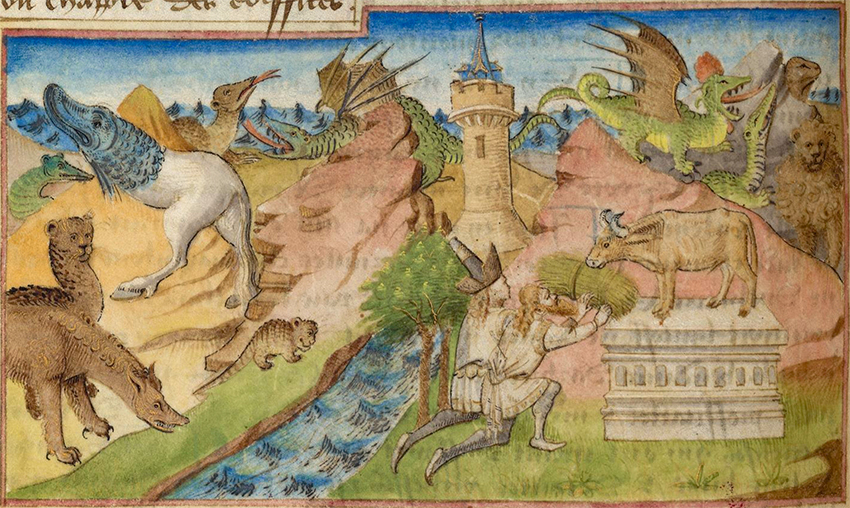
Despite being illustrated by two different artists, the illustrations in manuscripts A, B, C and D are similar in both style and content. The earliest (known) manuscripts are A and B; they have the same artist, so the similarity there is unremarkable. But manuscripts C and D, produced 20 years later and by a different artist, are also very similar to the first two manuscripts; though the details of content and style differ, they are similar enough to be sure they were based on manuscript A and/or B. The illustrations in manuscript E, done by a different artist a further 20 years after C and D, are very different in both content and style.
The illustrations were done by three artists, two of which are unnamed but are identified based on other manuscripts they illustrated. Manuscripts A and B are by the (unnamed) Master of Marguerite d'Orléans. Manuscripts C and D are by the (unnamed) Master of the Geneva Boccaccio. Manuscript E is by the known artist Robinet Testard.
A comparison of the illustrations of the same chapter for all five manuscripts can be seen in the Extras section of this article.
Chapters
The text is in two parts. The first part is a geography of countries throughout Europe, Asia and Africa, with each country having its own chapter (1-56). The chapters start with an illustration of some of the animals, people and features of the country, followed by a rather rambling account of attributes of and stories about the region.
In the following table of the chapters of part one, the country or region name (Region column) is based on the transcription/translation of manuscript E by Friedman and Kristen Figg; the other manuscripts use approximately the same names, though there are variations in spelling. The Modern column shows the name the region has now. The Animals column lists the animals that have significant mentions in that chapter (animals mentioned in passing are omitted). The Sources column lists the commonly-used names of sources the author attributes quotations and other information to. The four lettered columns at the end represent the letter codes of the four manuscripts listed above, with the folio location of the start of the chapter (i.e. the illustration). Manuscript A is in three volumes; the Roman numeral before the folio in the A column is the volume number (I - fr. 1377, II - fr. 1378, III - fr. 1379). Manuscript D is missing the first 22 chapters and starts with chapter 23. Manuscript B, with only two images, is not included here.
The geographic chapters are ordered alphabetically in the text by the region name. Almost all of the manuscripts follow this order, except for chapter 51 (Trapo), which is out order in manuscript E where it appears as chapter 49. The chapter is missing in manuscript D because of the loss of a folio.
Manuscript D is missing at least 57 folios. Chapters that are entirely missing are marked with —; chapters where part is missing are marked with * before or after the folio pagination number (before means the start of the chapter is missing, after means the end is missing).
| Ch | Region | Modern | Animals | Sources | A | C | D | E |
|---|---|---|---|---|---|---|---|---|
| 1 | Affricque | Africa | Basilisk, bear, crow, dove, elephant, hyena, lion, onager, snake, spider, trogodite | Pliny, Seneca, Solinus | I.1r | 4r | — | 1r |
| 2 | Amazonnye | Amazonia | Isidore, Orosius, Solinus | I.2v | 5v | — | 2r | |
| 3 | Angleterre | England | Horse, pig, stork, swan, weasel | Gervase | I.4r | 6v | — | 3r |
| 4 | Arabie | Arabia | Asp, camel, cinnamologus, dragon, horse, pearl-oyster, phoenix, pig, snake | Isidore, Lucan, Marbode, Pliny, Solinus | I.8r | 10r | — | 6r |
| 5 | Asia | Asia | Isidore, Orosius | I.10r | 12r | — | 7v | |
| 6 | Bactria | Bactria (Iran) | Camel | I.10v | 12r | — | 8r | |
| 7 | Boccia | Boeotia (Greece) | Ox | I.11r | 12v | — | 8v | |
| 8 | Bahaigne | Bohemia (Germany) | Loz | I.11v | 13r | — | 9r | |
| 9 | Bretaignela Grant | Great Britain | Snake | Solinus | I.12v | 13v | — | 9v |
| 10 | Champaigne | Campania (Italy) | Fly | Gervase, Virgil | I.14v | 15v | — | 11r |
| 11 | Cedar | Kedar | Isidore, Methodius | I.17r | 17v | — | 13r | |
| 12 | Chypre | Cyprus | Gervase | I.18r | 18v | — | 13v | |
| 13 | Crete | Crete | Bee, bull, fly, goat, sheep, stag | Isidore, Pliny, Solinus | I.19r | 19v | — | 14v |
| 14 | Egiptela Basse | Lower Egypt | Basilisk, catoblepas, crocodile, hippopotamus, ibis, leopard, lion, ox | Pliny, Solinus | I.20v | 21r | — | 15v |
| 15 | Egiptela Haulte | Upper Egypt | Centaur, crow, ox, wild man | Augustine, Gervase, Pomponius, Postumanus | I.22v | 22v | — | 16v |
| 16 | Elespont | Hellespont (Greece) | Crates, Pomponius, Solinus | I.25v | 25r | — | 18v | |
| 17 | Eolyes | Aeolians | Solinus | I.26v | 26r | — | 18v | |
| 18 | Ethioppie | Ethiopia | Asp, basilisk, dog, dragon, eel, elephant, elephant, lion, lobster, lizard, panther, pegasus, porcupine, snake, stork, tiger, tragopan, unicorn | Isidore, Josephus, Pliny, Solinus | I.27r | 26v | — | 20r |
| 19 | Europpe | Europe | Herodotus | II.1r | 31v | — | 23v | |
| 20 | Frise | Frisia (Germany) | Solinus | II.1v | 32r | — | 24r | |
| 21 | Fortunes | Fortunate Isles | Bee, cow, dog, goat, sheep | II.2r | 33r | — | 24r | |
| 22 | Gaule | Gaul (France) | Bedbug, beetle, flea, fly, wolf (werewolf) | Gervase, Herodotus, Isidore, Livy, Pliny, Solinus | II.2v | 33v | *1r | 25r |
| 23 | Germanie | Germany | Elephant, elk (“alerdes”), hercinia, nesontes, ox | Solinus | II.7r | 37v | 1r | 28r |
| 24 | Espaigne | Spain | Horse | Gervase, Pliny, Solinus, Vincent | II.8r | 38r | 1v | 28v |
| 25 | Ibernie | Ibernia (Ireland) | Gerald, Isidore, Solinus | II.10v | 40r | 4r | 30r | |
| 26 | Inde | India | Bat, dragon, elephant, hen, hydra, mouse, ox, snake, unicorn | Gervase, Isidore, Odericus, Pliny, Solinus | II.11v | 41v | 5r | 31r |
| 27 | Isle | Isidore | II.21r | 50r | 13r | 37r | ||
| 28 | Irllande | Iceland | Bear | II.21v | 50v | 13v | 37v | |
| 29 | Italie | Italy | Beaver, cicada, frog | Gervase, Solinus | II.22r | 51r | 14r | 38r |
| 30 | Judee | Judea (Palestine) | Gervase, Pliny, Solinus | II.25r | 53v | 16v* | 40r | |
| 31 | Libie | Libya | Bear, dragon, leopard, lion, tiger | II.26v | 55v | — | 41r | |
| 32 | Sidonie | Lydonie (Germany) | Cow, horse, ox, pig, sheep | II.27r | 55v | — | 41v | |
| 33 | Lytonie | Lytonie (Scythia) | II.27v | 56r | — | 42r | ||
| 34 | Macedonie | Macedonia | Solinus | II.28r | 56v | 17r | 42v | |
| 35 | Melos | Melos (Greece) | Isidore | II.29r | 57v | 17v | 43r | |
| 36 | Medie | Media (Iran) | Snake | Solinus | II.29r | 57v | 18v | 43v |
| 37 | Messie | Moesia (Balkans) | Solinus | II.30v | 59r | 18v* | 44v | |
| 38 | Neorgie | Norway | Bear, beaver | II.30v | 59r | — | 44v | |
| 39 | Offir | Ophir | Ape, dragon, leopard, lion, lynx, peacock, snake, tiger | Bible (Kings), Solinus | II.31r | 59v | — | 45r |
| 40 | Paradis Terrestre | Terrestrial Paradise | Bible (Genesis) | II.32r | 60v | — | 46r | |
| 41 | Pigmee | Pygmy (Judea) | Crane, sheep, stork | Pliny | II.33r | 61v | — | 47r |
| 42 | Poictou | Poitou (France) | Barnacle goose, colgalleran birds, fly, mermaid, snake | Gervase, Solinus | II.33v | 62r | *20r | 47v |
| 43 | Provence | Provence (France) | Crow, worm | Gervase, Pliny | II.35v | 64r | 20r | 49r |
| 44 | Sabbe | Saba (Arabia) | Phoenix | Bible (Kings) | II.40r | 68v | 24v | 52v |
| 45 | Saxone | Saxony | Ape, bear, boar, stag | II.40v | 69r | 25r | 53r | |
| 46 | Sardeigne | Sardinia | Bible (Daniel) | II.41r | 69v | 25v | 53v | |
| 47 | Scicie | Scythia | Dog, griffin, tiger, wolf (werewolf) | Pliny, Gervase, Solinus | II.42r | 70v | 26r | 54r |
| 48 | Scocie | Scotland | Eagle, falcon, fish, partridge | Gervase | II.46r | 73v | 29v | 56v |
| 49 | Sirie | Syria | Gervase | III.1 | 74v | 30r | 57v | |
| 50 | Seres | Seres (China) | Dragon, snake, silkworm, tiger, wolf | III.1v | 75r | 30v* | 58r | |
| 51 | Trapo | Trapo (India) | III.2v | 76r | — | 57r | ||
| 52 | Tuscane | Tuscany | Gervase, Isidore | III.2v | 76r | *31r | 59r | |
| 53 | Tile | Thule | Pliny, Solinus | III.3r | 76v | 31r | 59v | |
| 54 | Tracie | Thrace (Byzantium) | Solinus | III.4r | 77v | 31v | 60r | |
| 55 | Traponee | Traponee (Sri Lanka) | Birds, snail | Solinus | III.4v | 78r | 32r | 60v |
| 56 | Ululandef | Vinland (Norway) | III.5v | 79r | 33r | 61v |
Part two is an encyclopedia (chapters 57-73) providing accounts of the human body, animals and birds, cosmology, water, the earth, plants and other subjects.
In manuscript A (three volumes), part 2 begins at the end of volume III (chapters 57-65) and concludes at the end of volume I (chapters 66-73).
Manuscript D is missing several chapters at the end. Chapters that are entirely missing are marked with —. Chapter 65 is missing its ending.
In the following table the Title column (English and French) is based on the transcription/translation of manuscript E by Friedman and Kristen Figg; the other manuscripts use approximately the same titles. The Animals column lists the animals that have significant mentions in that chapter (animals mentioned in passing are omitted). The Sources column lists the commonly-used names of sources the author attributes quotations and other information to. The four lettered columns at the end represent the letter codes of the four manuscripts listed above. Manuscript A is in three volumes; the Roman numeral before the folio in the A column is the volume number (I - fr. 1377, II - fr. 1378, III - fr. 1379).
| Ch | Title | Animals | Sources | A | C | D | E |
|---|---|---|---|---|---|---|---|
| 57 | Wonders of the Human Body (Corps Humain) |
Bible, Pliny, Gervase, Seneca, Solinus | III.6v | 79v | 33v | 62r | |
| 58 | Wonders of the Animal World (Bestes Muez) |
Bear, capreola (chamois), chameleon, dog, dragon, elephant, fly, fox, frog, grasshopper, hare, ibis, lion, locust, mandrake, mole, onager, ostrich, panther, rabbit, rat, snake, squirrel, stag, swallow, thamur, tiger, weasel, wolf; "arguis", "cauls"; “clister”, “hippothar” | Aristotle, Epiphanus, Gervase, Pliny, Varro | III.14v | 87v | 40v | 67r |
| 59 | Wonders of the Heavens (Celestes Impressions) |
Ant, dog, eagle, frog, sea-cow, silkworm | Bible, Gervase, Pliny | III.24v | 95v | 47v | 72v |
| 60 | Wonders of Fire (Feu et Choses Ardens) |
Pliny | III.28v | 99r | 51r | 75r | |
| 61 | Wonders of Birds (Oyseaulx) |
Bat, blackbird, cock, crane, dove, duck, eagle, goose, griffin, hen, hoopoe, jay, magpie, nightingale, owl, parrot, peacock, pearl-oyster, Pegasus, quail, siren, stork, swallow, tragopan, turtledove, wren; “logopus” | Domosiarchus, Pliny | III.30r | 100r | 52v | 76r |
| 62 | Wonders of the Sea (Haulte Mer) |
Cow, lamb, ox, sheep | Bible, Pliny | III.33r | 102r | 54r | 77r |
| 63 | Wonders of Fresh Waters (Eaux Doulces) |
Ox | Pliny | III.35v | 103r | 56r | 77v |
| 64 | Wonders of Fish (Poissons) |
Eel, frog, hippopotamus, ox, pearl-oyster, sea-cow, snail, echeneis, whale; “orbis” | Pliny | III.36v | 105v | 57v | 79v |
| 65 | Wonders of the Earth (Terre) |
Snake | Pliny | III.38v | 107r | 59r* | 80v |
| 66 | Wonders of Trees (Arbres) |
Cuckoo, dove | Pliny | I.33v | 110v | — | 82v |
| 67 | Wonders of Herbs (Herbes) |
Crane, lion, lynx, salamander, snake | Democritus, Pliny, Solinus | I.37r | 113r | — | 84v |
| 68 | Wonders of Stones (Pierres) |
Fire stones | Pliny | I.40v | 116r | — | 85v |
| 69 | On Human Industry (Engin et Industrie de Cueur humain) |
Snake, stork, ibis | Isidore, Josephus, Orosius, Pliny | I.41v | 116v | — | 86r |
| 70 | On Marvelous Buildings (Merveilleuses Edifficacions) |
Dog, dragon, fly | Democritus, Pliny, Solinus, Vincent | I.42v | 117v | — | 86v |
| 71 | On Poisons (Venin) |
Bear, boar, crocodile, elephant, fish, fly, toad, lion, moth, scorpion, snake, stag, viper, wasp | Pliny | I.45v | 121r | — | 89v |
| 72 | On Monstrosity (Monstrueuses Choses) |
Ass, bear, centaur, fox, horse, leopard, mule; “hippotaur” | Gervase, Pliny | I.49r | 124r | — | 91v |
| 73 | On Portents (Prodigieuses Nouvelletez) |
Cow, partridge, pig, wolf (werewolf) | Augustine, Orosius, Pliny | I.52r | 126v | — | 93r |