Texts : Livre des merveilles du monde

Chapter 1: Affricque (Africa)
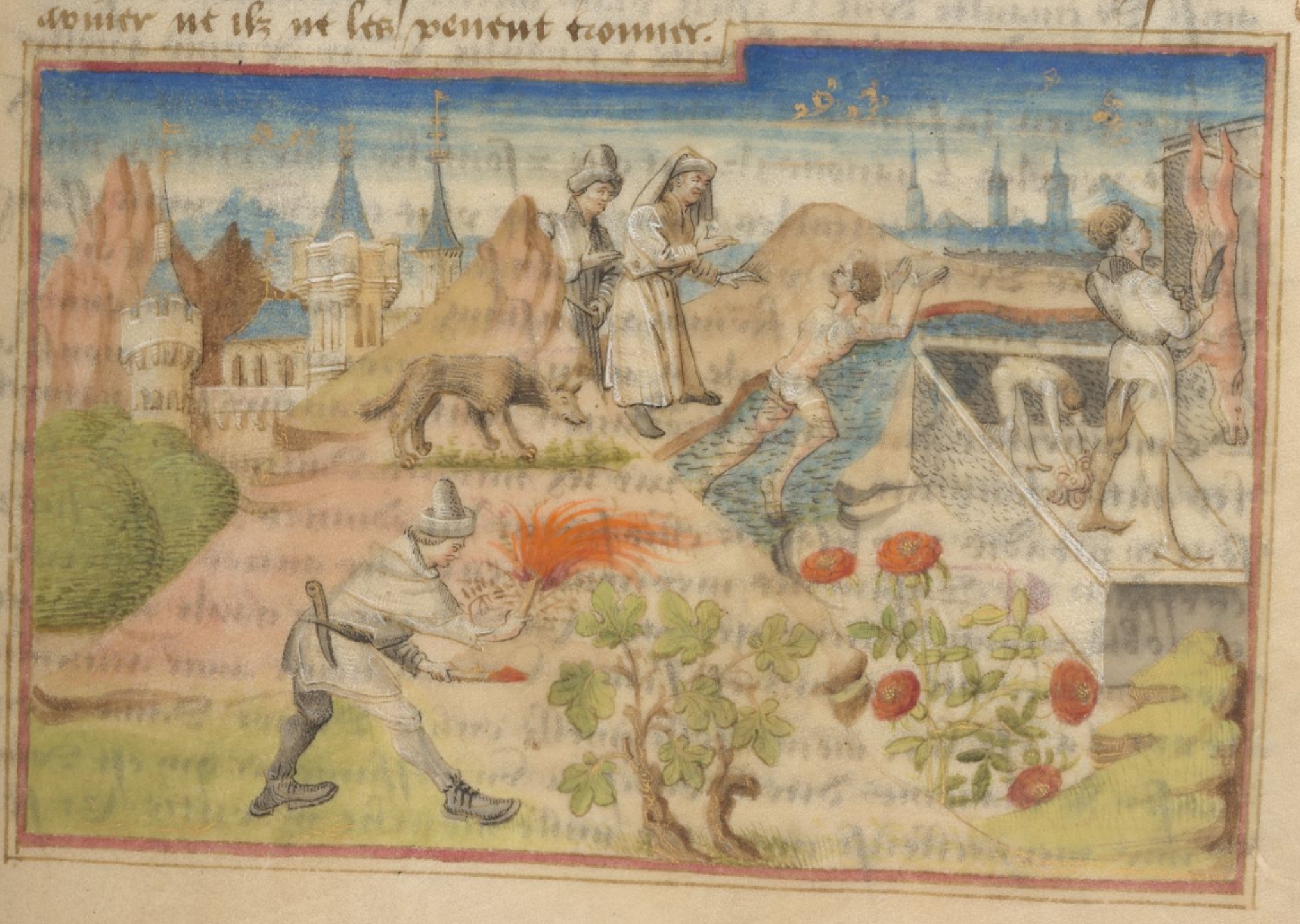
Affricque generallement comprinse est en la tierce partie de la terre, et est situee vers la region de mydi. En la quelle sont moult de grans lees et larges provinces, comme la grant Labie, tant renommee,et Numidie, Mauratanie,et la province des Penoies, la ou est Cartaigne la grand situee et fondee. De la quelle dit nostre maistre Solin que ampres la noble cite de Romme, Cartaigne estoit renommee comme la fleur et beaulte et le parement de tout le monde. En Affricque a ung treshault mont nomme Athas, qui contient depuis la partie devers midi jusques aux valees areneuses ou les sablons sont en continuel mouvement et jusques aux ysles ardans. En aucunes contrees de celle montaigne sont grands bois et grands forestz. De ceste montaigne la haultesse ne fut oncques actainte de homme ne marchee sinon du noble Perceuset Hercules le vaillant. Solin recite que en ceste montaigne a deux merveilles moult dignes. Lune merveille est que de jour la est merveilleuse silence. Car homme ny est veu ne congneu, mes est lieu secret et solitaire. Et de nuyt le dict lieu est clerement illumine de feu et dautres merveilleuses resplandisseurs. La sont oyes toutes doulces melodies et diverses voix et sonts dorgues, de harpes, et de toutes espesces dinstrumens de musicque. Ce nest pas encores venu a cognoissance de homme dont vient ceste lumiere ne quiest cause de ceste melodie. Lautre merveille est tresnotable, car en ce lieu la croissent certains arbres qui sont semblables a cypres qui sont vestuz dune maniere de mousse tres deliee et menue comme coton ou soye. Et des toizons de ces arbres on fait les futaines et les draps de soye. Et cecy defait tesmoigne le sageen soy accordant a Solin.
Item dit Solin que en celle montaigne croissent les bledz deleur bon gresans arer nesemer.
Item en celieu habondant elephans et toutes manieres de bestes sauvaiges, comme ours, lions, hyenes, asnes sauvaiges, onagres et serpens de moult diverses manieres. En Affricque sont les Sirtes maiours et minours, et sont sirtes unes manieres de perilz de mer qui viennent a cause des sablons mouvans que nous appellons la mer areneuse. Et sontes desers dAffricque pres dela mer. Et pour les grands vens tempestueux dela meret dela terre iceulx sablons tousjours floctentet sesmeuvent. Et dit Solin que des grands Sirtez jusques aux petites a deux cens mille. Et ne peut on aller dung lieu en lautre pour les perilz des sablons mouvans si non par le conduit des estoilles du ciel. Car la ne peut on trouver chemin, ne centier, ne trace dome, pour ce que le vent assemble le sablon dung lieu en aultre. Et la ou au jourduy aura montaigne desablon demain y aura vallee.
Item dit Solin que le fons de la mer prochaine de cestes dictes terres areneuses rend grands et horribles bouillons sablonneux. Et pour ce ne soist ne appartient a aucun marinier de passer par la pour le tresgrant peril destre assable. Combien que jadis le tresnoble et puissant navire de Romme passa par ce lieu seurement et sans nul peril par la prudence et proesse du saige conseiller Sequeina comme dient les Ystoires.
Neantmoins la chevallerie et le puissant ost que Perces, le roy de Perce, avoit envoye pour ravyr, enporter,etenlever les tresorset les despoilles du temple de Jupiter le riche, tout demeura et furent mors et perillez esdictes sirteset perilz sabloneux.
En Affricque comme dit Solin a une maniere de peuple nomme Sillus pour ce que jadis ainsi fut nomme ung roy deleur pays dont le sepulchre est encores monstre clerement entre les grands sirtes et les sirtes mineurs. Comme dit Plinien ou vii eme livre, celuy peuple et leur generacion sont entre les serpens tres asseures, fermes, et constans, et aussi entre les bestes venimeuses, laquelle chose est contre nature humaine. Car vous savez que serpens et toutes bestes venineuses sont contraires et desplaisans a toute nature humaine. Et pour ce je dy que ce peuple cy est de nature serpentine et venineuse, car ilz ne peuent estre bleciez de morsure de serpent ne nul venin neleur puit nuyre. Et dit Plinien que quant aucun homme du pays a ung enffent nouvellement ne et quil doubte ou ayt aucune suspection de la loiaute de la mere, pour approuver si lenffent est legitime ou non, il lexposeet mect devant les serpens, et si lenffent de la propriete et du sang perpetuel est engendre par celluy qui le livre aux serpens, les serpens ne luy font nul mal. Et si lenffent est engendre daultre pere et il soit mys devant les serpens tantost ilest menge et devore hastivement. Icy dit nostre acteur Solin que [en] Affricques sont les basilicques qui de leur seul regard octient les creatures. Car de leur regard ilz empoisonnent lair. Et dit listoire une chose notable que en lieu ou est le basilicque soit vif ou mort ja ny ent[r]erra osel volant ne mouche. Et dit que les Pargameniens quant ilz ediffierent a leur dieu Appolin le tresgrant et noble temple, ilz vindrent en Affricque pour achapter trescherement les ossemens ou relicques du basilicqueet les misdrent en leur temple comme notables joyaulx afin quela jamais nentrast oisel, corneille volant, ne coulon qui les temples ordoiassent de leurs fiens, ne mouches qui les charoignes suyvent des bestes mortes en leurs sacrifices, ne auxi araigne fillant jamais toille ny tissast. En Affricque a une province dicte Gramancie ou est une fontaine merveilleuse qui est de jour tresfroide comme glace et de nuyt treschaudeet ardant comme eaue boullant.
Item dit Solin que les bestes daumaille comme beufs et vaches sont peissens es pres la teste de coste ung oel vers la terre, et lautre vers le soleil. Pour ce ont la gueulle de travers; la cause si est car ilz ont les cornes recourbees et estandues vers la terre et ainsi les empeschent a pestre lerbe, la teste droit a la terre. Et leur fault la teste tourner et renverser pour pasturer ou aultrement elles ne pouroient manger,et conviendroit quelles mourussent defaim, et tout ainsi et semblablement il est des brebiz et moustons qui sont en celle contree.
Africa, as it is generally understood, is in the third part of the earth, and it is situated towards the South. In it are many great districts and large provinces like vast Libya, so renowned, Numidia, Mauritania, and the province of Penoyes, the place where the great city of Carthage was situated and built. And concerning this place our master Solinus says that after the noble city of Rome, Carthage was renowned as the flower, and the beauty, and the ornament of the entire world.In Africa there is a very high mountain range called Atlas, which extends from the area towards the South as far as the immense valleys of sand dunes, or Syrtes, where the sands are in continual movement, and as far as the burning islands. In some parts of this high mountain range are extensive woods and forests. The peak of these mountains was never reached by any man nor trodden upon except by the noble Perseus and the valiant Hercules. Solinus says that in the Atlas Mountains are two most worthy marvels. One wonder is that by day there is marvelous silence. For it is a place where men are not seen or known, but rather it is a secret and solitary place. And by night this place is brightly lit by fire and other marvelous resplendencies. There are heard sweet melodies and different voices and sounds of organs, of harps, and of all kinds of musical instruments.No one yet knows where this light comes from, nor what causes this melody. The other marvel is very notable, for in this place grow certain trees, similar to the cypress, which are covered in a kind of very fine and delicate moss, like cotton or silk. And from the "fleeces" of these trees are made soutanes and silk cloths. And this fact is witnessed by wise men, in agreement with Solinus.
Solinus says that on this mountain grains grow of their own free will, without tilling or sowing.
And here too are an abundance of elephants and all sorts of wild animals such as bears, lions, hyenas, wild asses, onagers, and serpents of many different kinds. In Africa are the Major and Minor Syrtes, and these dunes are like a kind of sea peril because of the moving sands that we call the sandy sea. And these moving sands are in the deserts of Africa near the sea. And because of the great winds from sea tempests and land storms, these sands are always flowing and in motion. And Solinus says that from the larger Syrtes to the smaller is a distance of two hundred miles. And one cannot go from one place to the other because of the dangers of these shifting sands, except by following the stars in the heavens. For one can find there neither road nor path nor human footprint because of the way the wind moves the sand from one place to another. And where today there is a mountain of sand, tomorrow there will be a valley.
Solinus says that the bottom of the sea near these aforementioned sandy areas sends up great and horrible sandy bubbles. And because of this, it does not fall to any mariner to pass through there, by reason of the very great risk of being buried by the sands.Though long ago the very noble and powerful fleet of Rome passed by this place safely and without peril through the prudence and prowess of the wise counselor Seneca, as is told in the Histories.
Nonetheless the horsemen and the powerful host that Perseus the king of Persia had sent to steal and carry off the treasure and spoils of the Temple of the rich Jupiter were all stopped there, killed and struck down by the aforesaid place and its sandy perils.
There are in Africa as Solinus says a manner of people named Sillius because formerly there was a king of their country thus named, whose tomb is still easily to be found between the greater and the smaller Syrtes. As Pliny says in Book Seven of the Natural History, these people and their offspring live among serpents in a very confident, firm, and constant manner, and also among venomous beasts, which is contrary to human nature. For you know that serpents and all venomous beasts are contrary and displeasing to all human nature. And for this reason I say that these people are by nature serpentine and venomous, for they cannot be wounded by the bite of a serpent, nor can any venom trouble them. And Pliny says that when any man of this country has a newborn child and he doubts or has any suspicion regarding the mother’s fidelity, in order to determine if the child is legitimate or not, he exposes it and lays it before serpents, and if the child is truly by nature and blood the offspring of the man who delivers it to the serpents, the serpents will not harm it. But if the child was fathered by another and is put before the serpents, it is immediately eaten and devoured. Here our authority Solinus says that in Africa are basilisks that can kill creatures by a single glance. For with their look they poison the air. And the History says a remarkable thing about them, that in any place where a basilisk is found, either living or dead, no bird or fly will enter. And he says that the Pergamenes, when they built their very grand and noble temple for Apollo, traveled to Africa in order to buy at great expense the bones or remains of the basilisk and put them in their temple as respected jewels in order that there would never enter there any bird, flying crow, or dove that would dirty the temple with its droppings, nor any flies that lived on the carrion of the animals killed for their sacrifices, nor even any spinning spider weaving a web. In Africa is a province called Garamantie where there is a marvelous fountain that is by day as cold as ice and by night hot and scalding as boiling water.
Solinus says that livestock there such as steers and cows graze in the field with the head turned to the side, one eye towards the ground and the other towards the sky. Thus they hold their throats sideways. The reason is that their horns are bent backwards and stretched out towards the earth and thus their horns prevent them from grazing on the grass with their heads right to the ground. And it is necessary for them to turn their heads to graze or else they could not eat and they would have to die of hunger; and it is exactly the same for the sheep and lambs that live in that country.
Chapter 55: Traponee (Sri Lanka)
Traponee est une ysle qui est situee bien pres de Inde la Maior, devers la partie de mydy, de laquelle parle Solin et dit que avant que Alyxandre envoiast en celle ysle son navire et ses gens darmes et ambassadeurs, il estoit en telle erreur et oultrecuydance quil cuydoit estre seul dieu et le plus puissant roy du monde.
Item dit Solin que en celle terre le souleil y lieve a dextre. Et que la partie doccident y est a senestre. Et que les vii estoilles du Chariot du Ciel que nous appellons Septentrion nullement ne sont la veues ni apperceues, pour la lontaingne interposicion de la terre.
Item dit Solin quela lune nest aucunesfoiz point veue luyre en celle terre si non quant elle est plaine. Et ne luyst que despuis viii heures de mynuit jusques ung peu apres mynuit.
Item dit Solin que en lieu dela clarte dela lune ilz ont la lumiere et clarte dune tresbelle et clere estoille appellee Canopos, qui donne en celle contree, une tresgrant et reluisant lumiereet clarte de nuyt par terre et parmer. Maiselle ne donne passi tres grant clarte comme fait la lune.
Item dit Solin que pour ce que les mariniers, quant ilz sont en la mer qui est en celle contree ne peuent veoir ni choisir ou ciel lestoille qui les adresse que lon nommele Polartique qui est fichee au millieu de la roe, par laquelle ilz sceuent congnoistre et choisir les contrees, les terres,et les bons pors et les regions, ilz se advisent dung remede bien subtil. Car ilz prenent et font prandre et mectre en une caige dedans leurs vaisseaux certains oyseaulx qui sont de telle condicion quilz ne desirent tousjours que destre sur terre et aller a la terre. Et sentent bien quant ilz sont en la mer et de quel couste est la terre plus prochaine deulx. Et pour ce quant les mariniers sont esgarez en la meret quilz ont volunte daller et aborder a terre et a bon port, ilz prenent lung de leurs oyseaulx qui de sa naturelle condicion scet et congnoist bien ou est la plus prochaine terre. Adonc les mariniers len laissent aller et voller. Et de quelque couste que loyseau voyse les mariniers le suyvront et nageront apres. Et par le moyen de cest oysel ilz arriveront a portet a terre.
Item dit Solin que le peuple de Traponee si a de coustume de faire et eslire a leur roy en commun tous dung acord ung homme qui sera de bonne renommee, preux, saige, loyal, et plain de bonnes meurs, et qui sera doulx et de bonnaire. Et comment quil soit de leage delx anset plus et quil nait nulz enffans.
Item de quelque sagesse, proesse et honneur quil soit plain, ja du peuple il naura le gouvernement si non seullement son estat royal. Et sil advient que despuis quil est fait et constitue roy quil soit marie et quesa femme ait enfans masles. Tantost ilsera despouse et destitue de son royaulme par le commun peuple. Car ilz ne veulent point avoir roys successeurs a leur royaulme par lignee et droit de succession. Mais les veulent avoir par commune election.
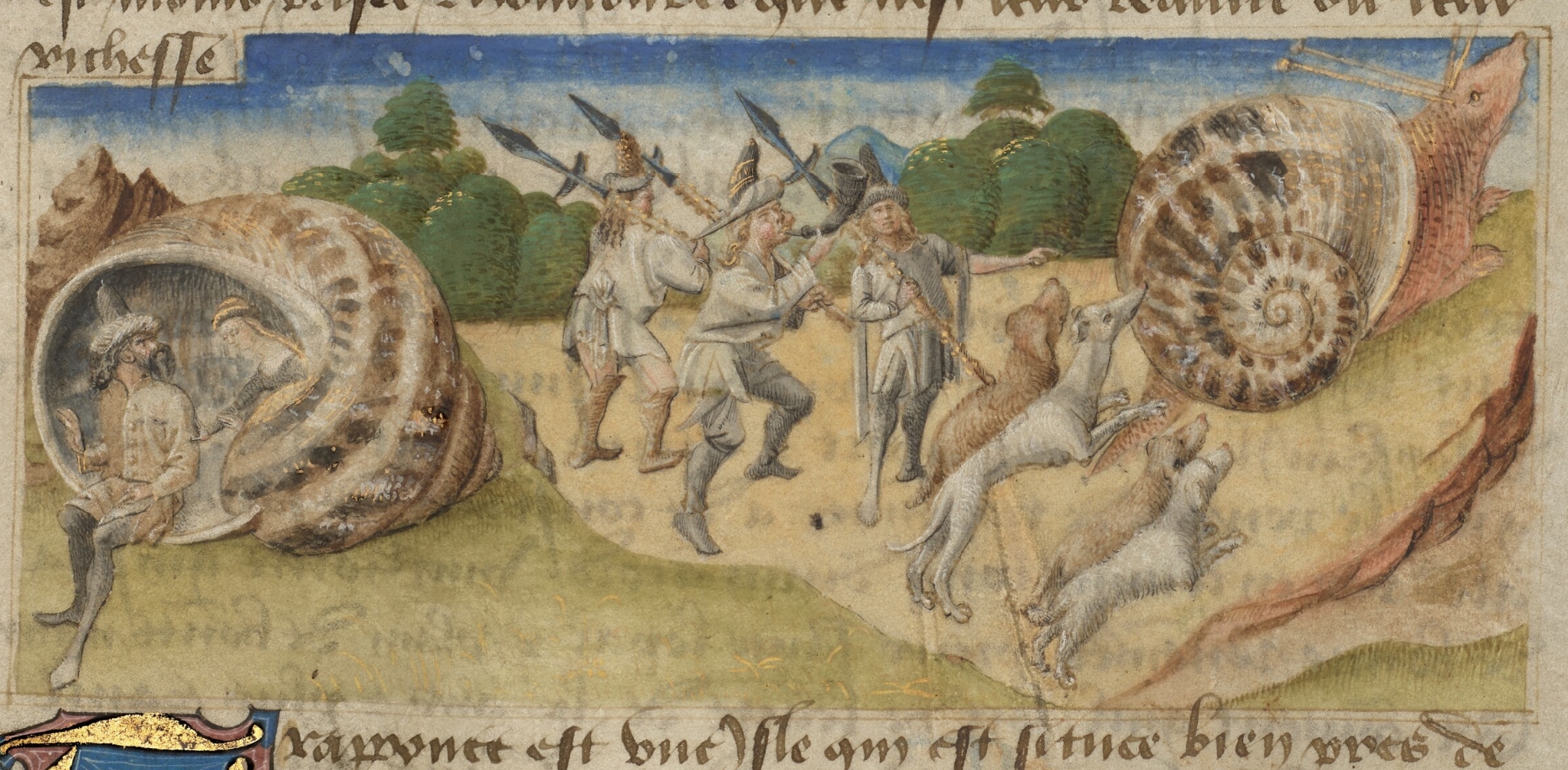
Item dit Solin que en lissue de Trapponee croissent les plus grans limassons qui soient ou monde et vont si trestoust que cest merveilles, et les chassent et venent les gens du pays comme nous faisons de pardeca les bestes sauvaiges. Et vivent les gens du pais de leur char. Et se hebergent les hommes et femmes du pais dedans leurs coques, tant sont grandes, et nont nulles autre maisons ne habitacions.
Traponee is an island which is situated very near India the Great, toward the Southern part, of which Solinus speaks and says that before Alexander sent his navy and his soldiers and ambassadors to this island, he was in such a state of error and foolish pride that he believed himself to be the only god and the most powerful king in the world.
Solinus says that in this land the sun rises on the right. And that the Western part is on the left. And that the seven stars of the Chariot of Heaven that we call the Septentrion are never viewed or seen there because of the distant interposition of the earth.
Solinus says that the moon is never seen to be shining in this land except when it is full. And it shines only from eight hours before midnight until a little after midnight.
Solinus says that in place of the light of the moon, they have the light and radiance of a very beautiful and bright star called Canopos, which gives, in this country, a very great and shining light and radiance at night on land and on sea. But it does not give such very bright light as the moon does.
Solinus says that because sailors, when they are on the sea that is in this country, cannot see or pick out in the sky the star that guides them, which is called the Polartique and which is located in the middle of the wheel of the heavens, by which they knew how to recognize and choose the countries, the lands, and the good ports and regions, they gain information through a very subtle alternative means. For they trap and have taken and put into a cage on their boats certain birds that are of such a nature that they desire only to be on land and go towards the land. And they fully recognize when they are at sea and on which side they will find land closer to them. And for this reason when the sailors are lost at sea and they wish to travel to and arrive at land and a good port, they take out one of their birds that by its nature knows and is fully aware of where the nearest land is to be found.Then the mariners let it go and fly away. And whichever side the bird goes to, the sailors will follow it and sail after. And by this means they will arrive at the port and land.
Solinus says that the people of Traponee have the custom of creating and electing as their king, in common and of one accord, a man who will be of good reputation, worthy, wise, loyal, and morally sound, and who will be mild and gentle. And he must have reached the age of 50 or more and have no children.
No matter how filled he may be with wisdom, prowess, and honor, he will never have the government of the people except only through his royal estate. And if it comes about that after he has been made king he gets married and his wife has male children, he will immediately be deposed and his realm will be taken from him by the common people. For they do not wish to have kings who succeed to their realm by lineage and right of succession. But rather, they wish to have them by common election.
Solinus says that among the progeny of Traponee grow the biggest snails that exist in the world, and they move so quickly that it is a marvel, and the men of the country hunt and chase them as we over here hunt wild animals. And the people of the region live on their flesh.And the shells are so big that the men and women of the country live inside them, and they have no other houses or habitations.