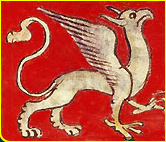
Gervase of Tilbury
Gervase of Tilbury (not the same person as Gervaise, author of a French verse Bestiaire) was probably born in the 1150s or early 1160s, possibly in Tilbury in Essex, England, though the only evidence of this is in his name. He traveled widely throughout Europe from ca. 1175 to 1225. He studied canon law in Bologna, was at the court of King Henry, served in the court of the king of Sicily and in the entourage of the archbishop of Arles in France, and possibly became a judge there. Based in Arles he continued his travels, collecting information wherever he went.
The Otia Imperialia
The Otia Imperialia, or Recreation for an Emperor, was written around 1214-1220. It was written for and dedicated to the Holy Roman Emperor Otto IV with the intent to provide the emperor with entertainment and education. In his first preface and in the preface to Book III, Gervase states his purpose in writing the book, saying (from S. E. Banks & J. W. Binns, ed., Gervase of Tilbury - Otia Imperialia - Recreation for an Emperor, page xxxvii-xxxix):
...the best remedy for a weary nature is to delight in novelties and to enjoy variety, and since it is not fitting that such sacred ears should be fanned by the lying breath of players, I have decided to present something for your hearing to refresh you in the midst of your worldly cares. ... [The book] was to contain a description, at least in brief, of the whole world, and its division into provinces, naming the greater and lesser sees. Then I intended to add the various marvels of each province. Their very existence is remarkable, and to hear of them should afford pleasure to a listener who is not already informed of them and is able to appreciate such things. ... our primary purpose is to present the marvels of every province to our discerning listener, in order that His Imperial Highness may have a source of refreshment for his thoughts when a clear interval of leisure is his.
He further defends the accuracy of stories in the preface to Book III (Banks & Binns, page 562):
Therefore no one should take the things we write to be idle tales, for our purpose in assembling them has not been to weary your venerable hearing with empty words, but the wish that, laying aside the lying fictions of players which are mingled with a small amount of truth, you may learn of marvels of which mere story-tellers have no knowledge, on reliable testimony deriving from the lands where they occur or from writers who vouch for them.
The Otia Imperialia is in three books:
Book I is on cosmology, the world and its creation: The origin of the world and its creation; the ordering of chaos; the ordering of the air; the sun, the moon, the stars, and the signs of the zodiac; the various ways of reckoning a year; the adornment of the air, and the winds; the spring and the four rivers; the dew of heaven, rain, and clouds; the sea; the invention of music and many other arts; the cause of the flood, the rainbow, and the ark.
Book II is on geography: A summary description of the three different parts of the world; the eastern part of Greater Asia, and its various regions and provinces; the regions of the southern part and of the northern part of Greater Asia; the various regions of Asia Minor; the regions of northern Europe, its provinces and cities; Italy, its provinces and cities; the topography of Rome; the western parts of Europe; the cities of Great Britain; Africa; the islands of the Mediterranean Sea; the sea and its nature.
Book III is on the wonders and marvels of the world: Various stones and their properties; the marvels of specific cities and localities; wonderous animals and plants; miraculous artifacts; legends and fables. Book III has 145 chapters, but many are very short. It is where most of the animals are described.
Manuscripts
There are 30 known manuscript copies of the Otia Imperialia, dating from the twelfth to seventeenth centuries. None are illustrated. The manuscript code letters below are those used in the edition by S. E. Banks & J. W. Binns, ed., Gervase of Tilbury - Otia Imperialia - Recreation for an Emperor. The manuscript list is from that edition and ARLIMA.
Animal Chapters
Gervaise relates the stories of several animals, mostly fabulous. Though he claims to have personal knowledge of some of the animals, for the most part his sources are other encyclopedias, folk tales and legends. His versions of the accounts often differ in some details from those told by earlier authors. After chapter 130, Gervase quotes extensively from the letter of Alexander the Great to Aristotle.
All quotes in the text below are from Banks & Binns.
Book II, Chapter 3 is about the wonders of India and Eastern Asia. It mentions the pearl-oyster, elephant, hyena, dragon, griffin, crane, eagle, snake, stag, leucrota, yale, manticore, ox, monocerus, eel, crab, crocodile, and sea-turtle. The animals are only briefly described, closely following the descriptions found in bestiaries and encyclopedias.
Book III, Preface describes the salamander as being nourished by fire, and that its skin, formed into a belt, could be cleaned by throwing into a fire (probably asbestos). Augustine of Hippo is said to have tested the story that peacock flesh never decays by keeping a piece for 30 days and seeing that it did not rot.
Book III, Chapter 1 tells of the loadstone (magnet) which attracts iron. Augustine of Hippo is said to have tested its properties by suspending a chain of iron rings from a magnet without connecting them, and to have put a piece of iron in a silver bowl and caused it to move by holding a magnet below.
Book III, Chapter 31 is on the boa: "...a snake was found [in a town of Dalmatia] by St Hilarion of an extraordinary size such as had never been seen before. In the native speech they call creatures of this kind boas, from the fact that they are so huge that they habitually gulp down oxen (boues)".
Book III, Chapter 44 tells of the beaver, "...an animal which goes on legs in its fore part, but ends as a fish for its bottom half; it always keeps its hinder part under water, but it rests its front on dry land."
Book III, Chapter 56 describes how silk is produced from the cocoons of the silkworm.
Book III, Chapter 63 is on the dolphin and other fish, such as the sea-monk and sea-dog. The story is told of how a sailor wounded a dolphin, was condemned to death by the other dolphins, and redeemed himself by healing the dolphin he had injured.
Book III, Chapter 64 tells of the sirens of the British sea, with the upper body of women and the lower body of fish. They are said to sit on the rocks and sing to passing sailors, who often become careless because of the enchantment and suffer shipwreck.
Book III, Chapter 65 is about the resourcefulness of animals. Three examples are given: the squirrel that uses its tail as a sail to cross water; the quail that lifts one wing to use as a sail when flying; and the onager, that when hunted by dogs squirts water into their eyes.
Book III, Chapter 68 reports on the cunning of the fox, that gets rid of fleas in its fur by dipping its tail in water and when the fleas move up its body moves more of its body under water, until the fleas leave.
Book III, Chapter 72 describes two serpents: the amphisbaena, with its two heads and glowing eyes; and the cerastes, with horns on its head it uses to gore people.
Book III, Chapter 73 tells of a beast called equinocephali. "...these creatures have horses’ manes. They are very strong, with huge teeth, and they breathe out flames." It also tells of the ants the size of dogs that gather gold; people who want the gold trick the ants by loading it onto camels while keeping the young camels on the opposite shore of a river. The adult camels swim to their young, bringing the gold with them.
Book III, Chapter 74 reports beasts called hippohugi, that are "...as swift as horses, have lions’ paws and horses’ necks, and are thirty feet long, twelve feet broad, and heavily built. If anyone tries to hunt a beast of this kind, it runs away so fast that no hunter can catch it or take its life; it suffers no harm from hunters at all."
Book III, Chapter 79 is about the phoenix that lives in Heliopolis, and burns itself to ash to rise again with its youth restored.
Book III, Chapter 104 repeats the Jewish legend of the thamur worm used by the ostrich to free her chick from a glass vessel. For more on this legend, see the encyclopedia article The Ostrich and the Thamur.
Book III, Chapter 116 is on the situla (dipsa) that is so small it is not seen before being stepped on, and so deadly that a person who is bitten dies before he feels pain.
Book III, Chapter 120 describes men who turn into wolves according to the cycle of the moon (i.e. werewolves). Gervase claims to know for certain of such beasts living in his country.
Book III, Chapter 123 is about the barnacle goose, birds that grow from trees, that is said to be "a strange thing, unheard of in any other country, that is of daily occurrence in a certain part of Great Britain".