Texts : Gervase of Tilbury
All excerpts below are from S. E. Banks, J. W. Binns, ed., Gervase of Tilbury - Otia Imperialia - Recreation for an Emperor.

Book I, Chapter 8: Cattle, the Creeping Things, and the Beasts
'Sexto die, cum creasset Deus iumenta, reptilia, et bestias,' iument in iuuamen, reptilia et bestias in exercitium, ad ultimum formauit hominem. Sane reptilium quedam sunt trahentia, ut uermes, ore se trahentes; quedam serpencia, ut colubri, ui costarum se rapientes; quedam repentia pedibus, ut lacerte.
Que uero ex humoribus uel coruptionibus lignorum (ut teredones) uel herbarum (ut tinee ex oleribus), uel fructuum (ut curculiones ex fabis); uel ex corruptione humorum (ut uermes puteorum); uel e cadaueribus (ut apes ex iumentis, scarabei ex equis, et scarabones, qu sunt musce grandes sonantes cum uolant): hec inquam omnia pos peccatum ex rebus corruptis orta sunt. Que uero ex exalationibus (ut bibiones ex uino, papiliones ex aqua) sexto die facta sunt.
Porro nociua animancia tribus de causis facta sunt: propter homini punitionem, ut cum his leditur aut ad timendum ducitur; propte correctionem, cum scit ista sibi accidisse propter peccatum; propte instructionem, ut per ista humilietur et opera Dei magis admiretur. Admiratur enim magis onera formicarum quam onera camelorum, et telam aranee quam opera manuum hominum.
'On the sixth day, after God had created the cattle, the creeping things, and the beasts' — the cattle to help us, the creeping things and the beasts to challenge us - in the last place he fashioned man. Now among the creeping things there are some which have a dragging movement, such as worms, which drag themselves along by their mouths; others have a wriggling movement, such as snakes, which pull themselves forward by the strength of their ribs; others again crawl on feet, such as lizards.
Some creatures emerge from dank and decaying matter, like rotten wood (such as wood-lice), or plants (such as caterpillars from vegetables), or fruit (such as weevils from beans); others come out of foul water (such as worms from wells); others again emerge from carcasses (such as bees from cattle, beetles from horses, and scarabos, which are large flies which make a noise when they fly): all these creatures, originating from corrupt matter, only appeared after the Fall. But those which come from vapours (such as wine-flies from wine, or dragonflies from water) were created on the sixth day.
Now pests were made for three reasons: for the punishment of man, which occurs when he is hurt by them or is reduced to a state of fear; for his amendment, when he realizes that these things have come to him on account of his sin; and for his instruction, in order that he may be humbled by them and marvel the more at the works of God. For. he marvels more at the burdens carried by ants than at those carried by camels, and more at a spider's web than at the works of human hands.
Book II, Chapter 3 (Eastern Asia and India)
Porro insula Taprobane, Indie subiacens ad eurum, occeano et Rubro mari circumducta, in longitudinem per milia passuum ..dcc. quinque, in latitudinem per stadia .dcxxv. protensa, tota margaritis repletur, habens in fine Indie, ubi elefantes nascuntur, ciuitatem Elmacidam, in confinio Taprobane ad terminos Rubri maris positam, hyenis’ elefantisque referta, duas estates et duas yemes fertur habere uno anno, et omni tempore uiret.
In Indico occeano quoque sunt Crisa et Arguse insule, auro et argento et omni metallo fecunde, et semper floride. Ibi sunt et monte aurei, qui propter dracones et grifes non possunt adiri.
In montanis Indie sunt Pigmei, duorum cubitorum homines, quibus cum gruibus pugna est.
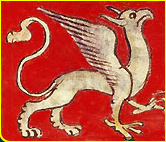
Habet et India Mencobrios, duodecim cubitorum homines, qu pugnam habent cum grifibus. Sane grifes corpora leonis habent, alas et ungulas aquilarum.
Sunt et in India tam uasti serpentes quod presertim ceruos deuorant, ipsumque occeanum transuadant. In India est bestia ceneocrota, cuius corpus asini, clunes cerui, pectus et crura leonis, pedes equini, ingens cornu bisulcum, uastus yatus, aures equine; loco dentium os solidum, os pene humanum. Illic est bestia eale, cuius corpus equi, maxilla apri, cauda elefantis, cubitalia cornua, quorum unum post tergum respicit; cum alio pugnat unum tenet obtusum, aliud ad certamen uibrat; nigro colere horrenda, in aqua et terra equaliter ualet. Illic sunt fului tauri uersis setis horrendi, grande caput habentes; oris rictus ab aure patet ad aurem. Profecto cornua uicissim ad pugnam producunt uel deponunt; omne telum missile duro tergo repellunt, qui si capti fuerint nulla possunt arte domari. Illic quoque manticora belua est faciem habens hominis, triplicem in dentibus ordinem, corpus leonis, caudam scorpionis, oculos glaucos, sanguinei colors, uocem sibili serpentini, humanas carnes in esu habet, fingens discrimina uocum, uelocior cursu quam ales uolatu. Illic sunt boues tricornes, pedes equinos habentes. Illic est monoceros, cuius corpus equi, caput cerui pedes elefantis, cauda suis; unum cornu habet in media fronte quatuor pedum longitudine protensum, splendens et mire acutum. Hec ferocissima diros habet mugitus, omne quod obstat conu transuerberat; capta perimi potest, domari non potest. Hanc rinocerotem dicunt, de qua in figura Pauli legitur in Tob: 'Numquid rinoceros seruiet mihi?'
In Gange fluuio Indiam influente sunt anguille tricenorum pedum longe. Illic sunt quidam uermes ad instar cancri; bina habentes brachia sex cubitorum longa, quibus elefantes corripiunt et undis inmergunt. Illic sunt cocodrilli, corporibus asperi et magni; in aqua potentissimi omniaque sub aqua domantes, ad terram ducti sua uirtute priuantur.
Indicum mare gignit testudines, de quarum testis homines capacia sibi faciunt hospitia.
The island of Taprobane, lying south-east of India and surrounded by the ocean and the Red Sea, is 805 miles long and 62 stades wide. The whole island is full of pearls. On the Indian side, where elephants live, it has the town of Elmacida, situated within the confines of Taprobane on the shores of the Red Sea. Taprobane is full of hyenas and elephants. It is said to have two summers and two winters each year, and it is always green.
Also in the Indian Ocean are the islands of Chrysa and Argare, rich in gold and silver and every metal, and always full of flowers. There are even mountains of gold there, but dragons and griffins prevent anyone from approaching them.
In the mountains of India are found the Pygmies, human creatures two cubits high, who fight with the cranes.
India is also the home of the Macrobii, human creatures twelve cubits high, who fight with the griffins. Griffins have the body of a lion and the wings and talons of an eagle.
Also in India there are snakes so huge that their diet consists chiefly of stags; they even cross the ocean. The animal called a leucrota is found in India: it has the body of an ass, the haunches of a stag, the chest and legs of a lion, horses' hooves, a huge forked horn, a wide open mouth, horses' ears, a solid bone in place of teeth, and a face that is nearly human. The animal known as a yale also lives there: it has the body of a horse, a boar's jaw, an elephant's tail, and horns a cubit long: One of these horns points behind its back, while the creature fights with the other; it keeps one out of action, while it brandishes the other ready for combat. It is a dreadful black colour, and is equally at home in water or on land. Tawny bulls are found there, whose hair stands on end in a horrible manner; they have a huge head, and their mouth gapes in a grin from ear to ear. They alternately extend their horns for battle and retract them; any missile bounces off their tough hide; and if they are ever captured no wiles can tame them. The beast called the manticore is found in India too: it has a human face, a triple row of teeth, a lion’s body, a scorpion's tail, and blazing eyes; it is the colour of blood, and has a voice like a snake's hiss, producing distinct notes; it feeds on human flesh, and can run faster than a bird can fly. There are three-horned oxen there, with horses' hooves. The unicorn is found there, a creature with the body of a horse, the head of a stag, the feet of an elephant, and the tail of a pig; in the middle of its forehead it has a single horn, projecting to a length of four feet, gleaming and wonderfully sharp. This beast is very fierce, and has a terrible bellow; it transfixes anything that stands in its way with its horn; if it is captured it can be killed, but not tamed. They call it a rhinoceros, and it is used in Job as a type of Paul: ‘Will the rhinoceros serve me?'
In the river Ganges flowing through India there are eels three hundred feet long. There are also worms there which are like crabs: they have two pincers six cubits long, with which they seize elephants and drown them underwater. Crocodiles are found there, with big, rough bodies; in the water they are extremely powerful and overcome everything they meet beneath its surface, but if they are brought to the land they are deprived of their strength.
The Indian Sea produces tortoises, from whose shells the people make roomy shelters for themselves.
Book III, Preface
Ecce enim uulgare notumque est salamandram in igne uiuere, cum ignis consumptiue sit nature, hec igne nutritur, non consumitur. Vidi equidem, cum nuper Rome essem, allatam a cardinali magistro Petro Capuano corrigiam de corio salamandre amply amuelut cincorium renum, et cum ex contrectatione aliquas sordes contraxisset, in ignem ipsam uidimus ab omni inquinamen purgatam et in nullo consumptam. Sed et dampnatissimi Sicilie montes, qui tanta temporis diuturnitate ac uetustate nunc ac deinceps flammis estuant et integri perseuerant, satis idonel testes sunt non omne quod ardet absumi, sicut indicant anime non omne quod dolere potest posse et mori.
Carnem quoque pauonis nulla temporis uetustate corrumpi testatur Augustinus in libro De ciuilate Dei, asserens se id ita probasse: cum enim ex auditis faceret periculum, frustrum ad octo dies coctum iussit conseruari intactum, quod cum exacto tempore incorruptum etiam per triginta dies seruasset integrum etiam post annum nihil os eius offendit olfatu, nisi quod aliquantulum corpulentie siccioris fuit et contractioris.
...it is a matter of common knowledge that the salamander lives in fire, and although fire is of a destructive nature, this creature is nourished by it, not destroyed. I myself saw, when I was lately in Rome, a strap of salamander skin about the size of a belt which had been brought there by the cardinal Master Peter of Capua. When it had picked up some dirt from being handled, it was put into a fire, and before our eyes the fire cleansed it of every stain, but did not burn it at all. The infernal mountains of Sicily also offer quite sufficient proof that not all that burns is destroyed: throughout the ages, from time immemorial up to the present, they have been seething with flames, and seem likely to continue; and yet they remain undamaged. Likewise souls show that not everything that can suffer can also die.
Augustine attests also, in his book City of God that a peacock's flesh does not decay no matter how old it is. He says that he proved it like this: conducting an experiment on the basis of what he had heard, he ordered a cooked piece of meat to be preserved untouched for eight days, and since when the time had passed it was unspoilt, he preserved it for another thirty days, and it was still fresh; even after a year it did not offend his nostrils at all by its smell: the only change was that the flesh had become a little dry and shrunken.
Book III, Chapter 56: Silk: Where it Comes From, and How it is Produced
Nunc annectamus de natura bombicis, que non minus erit admiranda. Est enim a sui principio quasi semen sinapis minutissimum cumque tempus aduenit, panniculis inclusum, coactum, illud semen in sinu dominarum ac uirginum tenetur; beneficio caloris uiuificatum, foliis mori superponitur. Sicque mira insitaque nature celeritate folia rodit, et super tabulam uermiculi extensi nutrimento foliorum mori in breui crescunt ad grossorum uermium quantitatem. Quid plura? Cum tempus operandi aduenit, globo serico continuantes ieiunium sericum ex se conficiunt, et post pauca in ipso, ad instar papilionum alati et in aeris libertatem iam recipiendi, globu penetrant quem fecerunt...
Let us now go on to treat of the nature of the silkworm, which will prove no less a cause of wonder. At the beginning of its life-cycle it resembles a tiny mustard-seed. When the time comes, that seed is placed in little cloths, wrapped up, and kept in the bosom of ladies and girls; the beneficial effect of the warmth brings it to life, and it is then laid on the leaves of a mulberry tree. And so, with the remarkable swiftness that is characteristic of it, it devours the leaves; the little grubs, spread out over a board, soon grow on the nourishment of those mulberry leaves to the size of fat worms. Why draw out my account? When the time comes for them to do their work, they entirely stop eating, and produce silk from themselves to form a silken cocoon; after spending a little time inside it, they break out of the cocoon which they made, winged like butterflies and now ready to enjoy the freedom of the air.
Book III, Chapter 63: Dolphins
Quisquis marini fluctus inuestigator extitit aut ipsius maris e plorator, audiat et constanter affirmet nullam in nostra habitatione terrena repertam cuiusuis animantis effigiem cuius” similitudinem non liceat in piscibus occeani Britannici ab umbilico superius speculari. Illic piscis monachus ad medium uentrem squama monachali piscem tegit; illic rex piscis est coronatus; illic miles armatus equitat; illic canis, rictum oris aperiens; illic porcus, quem dalfinum nominant, quem de genere militum esse uulgus auctumat, porcina sibi inter fluctus maris transmutata latenter effigie.
Anyone who has made a study of salt water or conducted explorations of the sea itself should listen to this, and staunchly confirm that there is no form of any creature found living among us on dry land whose likeness, from the navel upwards, may not be observed among the fish of the ocean off Britain. There the monk-fish covers itself to the middle of its belly with a scaly cowl; there the king-fish is found, wearing its crown; there the knight-fish rides in armour; there the dog-fish is seen, opening wide its jaws; there too is the pig-fish, which they call a dolphin: the people say that this fish is born as a knight, and puts on its piggish appearance secretly among the waves of the sea.
Book III, Chapter 64: The Sirens of the British Sea
Ad hec in mari Britannico serene scopulis insidere uidentur, que caput femineum, capillos lucidos et proceros habent, ubera muliebria omniaque feminee forme membra usque ad umbelicum; cetera in piscem finiuntur. He cantu dulcissimo sic nautarum transeuntium corda penetrant quod, suaui aurium pruritu admodum delectati officii sui fiunt immemores, et incauti naufragium persepe patiuntur.
...sirens are seen in the sea off Britain, sitting on the rocks. They have a female head, long, shining hair, a woman's breasts, and all the limbs of the female form down to the navel; the rest of their body tails off as a fish. With the immense sweetness of their singing these creatures so penetrate the hearts of passing sailors that they succumb utterly to the sensuous enticement of their ears; they become forgetful of their duty, and very often suffer shipwreck through carelessness.
Book III, Chapter 65: The Resourcefulness of Animals
Ecce miranda asperioli sagacitas, qui cum aquam transuadare propter sui modicitatem non sufficiat, frustulo ligni se superponit, et erecta cauda uelum facit, quo duce a subueniente flatu flumen possit transcurrere.
Sed et coturnices, cum ad yemandum insulas maris calidiores petunt, continuum uolandi laborem miro temperantie consilio adiuuant, dum unam ad instar ueli alam erigunt, et uicissim permutatis alis sibi subueniunt.
Porro apud Polloniam onagrorum frequens est uenatio, quorum cadem est fere natura que et asinorum: sunt enim asini siluestres cornua habentes ad modum damarum, melancolice complexionis; dum siccitatem habent innatam, sitibunda sunt. Cum ergo uenatorum cornua intonantia presentiunt, ad fontes properant, aque inmenso haustu se saciant, ut siccitatem, ex calore currentis adauctam, sumpti potus humiditate temperent. Enimuero canibus urgentibus, paulatim gradum sistunt; et superuenientes tanta inundatione per nares inuoluunt quod et excecatos diucius a sequendo retardant, et inter oculos obductos ad fugam citatam se accingunt.
Take the marvellous resourcefulness of the squirrel. When it is not able to ford a watercourse on account of its smallness, it ensconces itself on a little piece of wood and, raising its tail, makes a sail, by whose propulsion it can get across the stream with a helping breeze.
And quails, when they are heading for the warmer islands of the sea to pass the winter there, ease the continuous effort of flying by a remarkable measure to conserve their energy: they raise one wing like a sail, and give themselves relief by alternating from one wing to the other.
Further, in Poland onagers are often hunted. These animals are virtually identical to asses in their nature: they are in fact wild asses, with antlers like deer, and of a melancholic constitution. Since they have an innate dryness, they are thirsty creatures. Consequently, when they hear the warning of hunters’ horns being sounded, they rush to the springs and fill themselves with an enormous draught of water, so that when their dryness is increased by the heat of running, they may counterbalance it with the wetness of the drink they have taken. Then, with the dogs pressing hard upon them, they gradually slacken their pace; when the dogs overtake them, they overwhelm them with such a great deluge from their nostrils that they both hinder them from pursuing them for some time by blinding them, and give themselves the chance to run away quickly while the dogs' eyes are darkened.
Book III, Chapter 68: The Fox's Cunning
Cum naturalem uulpecule astuciam audimus, nihil aliud agimus nisi quod uitam nostram ad prudentiam augendam informamus. Ecce quod uulpes, ut se sentit pulicum pungentium amara lue grauari, aquam accedit, et retrogrado incessu caude summitatem aque immergit. Pulices igitur, ut humorem sentiunt, sicciorem partem corporis fugiendo occupant; sicque dum corpus a natibus aque paulatim infigit, pulices ad ultimam rictus partem ascendere compelluntur. Cum ad labra deducta fuerit infelix turba, ut os totum humectat, stuppe uel alii cuiuis molliori materie, quam paulo ante uulpes colectam in ore posuerat, pulices insiliunt; et cum sentit astutum animal ipsas triste mutasse asilum, stuppam ore proicit, et sic aqua exuit et peste nociua liberatur.
When we hear of the natural cunning of the little fox, it can only lead us to shape our own lives towards a growth in practical wisdom. Mark, then, that when a fox feels itself being tormented by the bites of a disagreeable plague of fleas, it goes to a river and, walking backwards, dips the tip of its tail into the water. The fleas, therefore, when they feel the wetness, run from the tail and take refuge in a drier part of the body; and so as it sinks its body little by little from the rump upwards into the water, the fleas are forced to climb up towards the very edge of its jaw. Once the unlucky band has been driven to its lips, it submerges its whole face: then the fleas leap into the tow or some other softish substance which the fox had picked up a little before and placed in its mouth. When the cunning animal feels that they have exchanged their uncomfortable refuge, it spits out the tow from its mouth, and thus comes up out of the water freed from the troublesome pest.
Book III, Chapter 72: Serpents
Seleucia Babiloniam pergentibus subiacet regio in Sidonia, in qua serpentes nascuntur immensi atque horrendi, habentes bina capita, quorum oculi lucent uelut lucerna. Nascuntur et onagri cornu et forma maximi.
Huic confinis Arabia iungitur, inculta propter serpentes cerastes nuncupatos, cornua arietina habentes, quibus homines uulnerant et perimunt.
There is a region in Sidonia, on the route travelled by people on their way from Seleucia to Babylonia, in which huge and horrible serpents are found: they have two heads, and their eyes shine like lamps [amphisbaena]. onagers are also found there, a horned variety, of huge dimensions.
Bordering on this land is its neighbour Arabia, uncultivated on account of the serpents called cerastes. They have rams’ horns, with which they gore and kill people.
Book III, Chapter 73: Gold-digging Ants
Est in eadem insula flumen Gargarum, trans quod nascuntur formice mirmidones, magnitudine catulorum, habentes pedes senos, et centrios quasi locuste marine; dentes canum habent colore nigre, aurumque custodiunt, quod proferunt de subterraneis ad lucem. Cum uero hominem aut animal quodlibet attigerint, ad ossa deuorant. Suntque uelocissime, ut magis uolare quam gradi censeantur. He sole oriente usque in horam quintam sub terra aurum fodiunt, et exinde in lucem producunt, quod ab artificibus ingeniosee extrahitur. Ducunt enim camelos quam plures et camelas cum pullis suis, et cum ad ripam transeundi fluminis peruenerint, ad riparios cespites pullos alligant. Transito itaque flumine cum utriusque sexus camelis, camelabus aurum imponunt, que onuste et amore pullorum allecte cursu festino transuadant. Comperientes igitur homines insequentium agmina formicarum, relictis ad fluuium et ad deuorandum expositis camelis masculis, celeri transitu flumen peragrant Sane formice, predonum captura fraudate, obiectorum camelorum deuoratione retardantur, et fluuio contradicente prepedite, faciunt quod possunt dum deuorant camelos quos inueniunt. Sic fit ut aurum illud obrizum ad nos usque perueniat.
On the same island is the river Gargarum, beyond which are found giant ants as big as puppies, each with six feet, and a body like a lobster's; they have dog's fangs, and are black in colour. They hoard gold, which they bring up to the light from underground. If ever they catch a human being or any living creature, they gnaw them down to the bones. They are very fast-moving, so that they appear to fly rather than walk. From sunrise until eleven o'clock they mine gold underground, and from that time on they bring it out into the light. It is ingeniously extracted from them by tricksters. For people take as many camels as possible, together with their mates and their young, and when they reach the bank of the river that has to be crossed, they tie the baby camels to clumps of bushes on the bank. They then cross the river with the camels of both sexes, and load the gold onto the female ones. These, loaded down, but enticed by the love of their young, make rapid headway in crossing the water. Then the men, as soon as they perceive columns of ants coming after them, leave the male camels by the river as an easy prey to be devoured, and hastily cross to the other side of the water. And in fact the ants, cheated as they have been by the robbers' looting, are hindered by their consumption of the camels left in their way, and impeded by the obstacle of the river, so that all they can do is devour the camels which they find. It is by such means that that pure gold reaches us.
Book III, Chapter 69: The Phoenix
Ad confinium Eliopolis mons est Adans, inascensibilis propter sui celsitudinem ... In hoc quoque monte auis est fenix, amplam habens uittam in capite, cristam similem orbiculari caude pauonis. In hac aue delicie solis esse’ referuntur: innumeris uiuit annis, ex sola, ut tradunt, diuinitate processit, ideoque amomo thureque uiuens, nido insidet ex margaritis ac unionibus conserto. Ex se nidoque combusto renascitur unde semper uiuere predicatur...
In the neighbourhood of Heliopolis is Mount Adans, unscalable on account of its height. ... Also found on this mountain is the phoenix, a bird with a wide fillet on its head, and a crest with a rounded spread like that of a peacock's tail. It is said that the sun takes delight in this bird: it lives for countless years, and sprang, so they say, from the Godhead alone; and so, living on amomum and frankincense, it sits in a nest which is studded with pearls, large and small. It is reborn from the combustion of itself and its nest, and for this reason it is said to live for ever...
Book III, Chapter 116: The Burning Fiery Serpents
Qui dipsades dicuntur, latine uero situle, quia perimunt hominem siti; adeo parue quod si conculcantur uix uidentur. Harum uenenum ante extinguit quam sentiatur, nec tristiciam sentit moriturus. Dicitur autem situla per contrarium uas enim quod situla dicitur sitim aufert, hec affert; sic faretra, quia infert mortem, et feretrum, quia fert uel aufert mortuum.
[The Israelites] had escaped the serpents which were burning everything around them with their breath. They are called thirsty, or in Latin situlae (buckets) [dipsa], because they kill a person by thirst (sitis). They are so small that if they are trodden underfoot they are hardly noticed. Their poison kills before it is felt, and the one about to die feels no distress. The name situla arises from an association of opposites: for the container which is called a situla takes away thirst, while this creature brings it on...
Book III, Chapter 123: Birds which Grow out of Trees
Cum secundum insitam prime creationis naturam ex primis generantibus animalia prodeant per generationem et corrupcionem, nouum et inauditum est apud omnes pereque nationes quod in quadam maioris Britannie parte cotidianum est. Ecce enim, in archiepiscopatu Cantuariensi, comitatu Cancio, ad confinium abbatie de Faueresham, in littore maris arbuscule nascuntur ad quantitatem salicum. Ex istis nodi pullulant, uelud future germinacionis prenuncii, cumque secundum tempora creationis excreuerint, formantur in auiculas. Que post dies nature datos, rostro dependent et uiuificate, facta leui alarum succusacione, quasi puerperio con sumato, in mare decidunt, et quandoque capiuntur ab indigenis quandoque marinis fluctibus exposite humanis contactibus subtrahuntur. Aues iste ad quantitatem modicorum anserum crescunt, pennis uariis et aucinis intermixte. Quadragesimali tempore assate comeduntur, considerata ad hoc pocius’ natiua processione quam carnis sapiditate. Auem uulgus bernectam nominat.
Complying with a property implanted in primal creation, from their first progenitors living creatures come into being through a process of generation and decay; but there is a strange thing, unheard of in any other country, that is of daily occurrence in a certain part of Great Britain. It is this: in the archdiocese of Canterbury, in the county of Kent, near Faversham Abbey, small trees grow on the sea-shore about the size of willows. From them nodes sprout, which look like the harbingers of future germination, but when they have grown for the time allotted in creation, they take on the shape of little birds. At the end of the number of days required by nature, these birds hang down by their beaks and come to life with a light fluttering of their wings; then, with their incubation, as it were, complete, they drop into the sea. Sometimes they are caught by the locals, but sometimes they go free on the ocean-waves, escaping human grasp. These birds grow to the size of small geese, their plumage consisting of a mixture of goose and other feathers. In the season of Lent they are roasted and eaten, their manner of birth being taken into consideration for this rather than the fact that they taste of meat. The people call this bird the barnacle goose.