The Ostrich and the Thamur
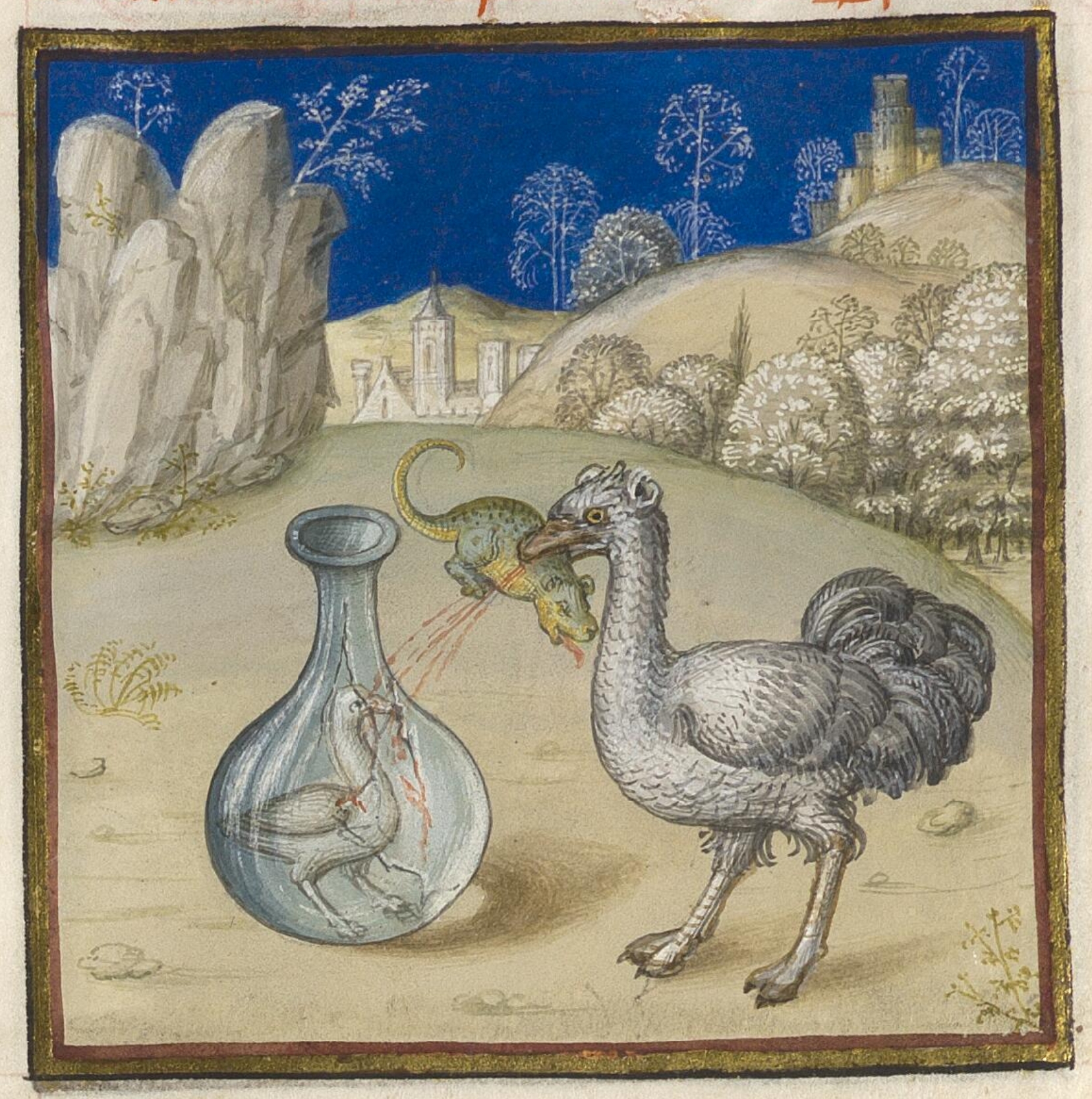

The story of the ostrich and the thamur worm has ancient origins, and followed a winding path to become the legend known in the middle ages. It is like a puzzle with a piece missing.
Several versions of the story are found below. For more quotes from the sources, click the Texts tab above.
Early Jewish Texts
The story begins with the shamir (שמיר), which the Jewish Mishnah (Pirkei Avot 5:6) says was the seventh of ten wondrous/magical things created on the sixth day of creation on the eve of the Sabbath at twilight. The text does not say what the shamir was or how it was to be used. The word shamir can refer to a very hard substance, like diamond or flint. Its properties are explained in the Tosefta Sotah 15:
Said Rabbi Yehuda, what was this "shamir"? It was created on the sixth day of creation. When it is placed on top of stones, [or] on top of beams, cuts them opens as though they are two boards of a writing tablet, and not only that, but when it is placed on top of iron, it would split it open from top to bottom, and there was nothing that could withstand it. How did they do it (i.e., restrain it)? They would bind it up in a soft woolen cloth, and place it inside a lead cylinder filled with bran flour.
This does not explain what the shamir was. It is further clarified in the commentary Bartenura on Pirkei Avot 5:6:
It is like a type of worm, the [size of a grain of] barley in its entirety. When they would [place] it on the stones that were marked with ink [to demark what they wanted cut, the stones] would become indented on their own. And with it did they engrave the stones of the vest (ephod) and the breastplate [of the high priest]...
The story of how Solomon used the shamir to cut the stones for the temple is told in the Babylonian Talmud: Tractate Gittin 68a/b (for two longer versions of the story, see the Texts tab above):
As it is written with regard to the building of the Temple: “For the house, when it was being built, was built of stone made ready at the quarry; and there was neither hammer nor axe nor any tool of iron heard in the house, while it was being built” [I Kings 6:7]. Solomon said to the sages: How shall I make it so that the stone will be precisely cut without using iron? They said to him: There is a creature called a shamir that can cut the stones, which Moses brought and used to cut the stones of the ephod. ... Solomon said to [the demon Ashmedai]: I need nothing from you. I want to build the Temple and I need the shamir for this. Ashmedai said to him: The shamir was not given to me, but it was given to the angelic minister of the sea. And he gives it only to the wild rooster, also known as the dukhifat or the hoopoe, whom he trusts by the force of his oath to return it. ... And what does the wild rooster do with it? He brings it to mountains that are not fit for habitation, and he places the shamir on the craggy rock and the mountain splits. And he takes and brings seeds of trees, throws them there, and it becomes fit for habitation. And this is why we interpret the word dukhifat as a cutter of mountains ... They investigated and found the nest of a wild rooster in which there were chicks, and he covered its nest with translucent glass. When the rooster came it wanted to enter the nest but was unable to do so. It went and brought the shamir and placed it on top to crack the glass. Solomon’s servant threw a clump of dirt at the rooster and the rooster knocked over the shamir. The man took it and the wild rooster went and strangled itself over the fact that it had not kept its oath, by not returning the shamir.
In English translations of the Jewish texts the bird is variously called the hoopoe (דּוּכִיפַת), or the wild cock (הדוכיפת) or the wood-cock (חרטומן יערות). The most commonly accepted name is hoopoe, listed as one of the unclean birds in Jewish dietary law. The hoopoe was found in Palestine during biblical times.
From the commentary Rabbeinu Bahya, Vayikra 11:19:
דּוּכִיפַת, “the duchifass.” This is a wild rooster whose comb is doubled over and according to Rashi the bird known as hoopoe. It brought the shamir worm to the Temple (not deliberately) to enable Solomon to split stones without having to use metal tools.
So by the sixth century when the Jewish texts were compiled, the worm was the shamir and the bird was the dukhifat or hoopoe.
The Story in the Middle Ages
There are several centuries between the compilation of the Jewish Talmud and Mishna and the retelling of the story by medieval western European authors. The legend appears to have only been discovered in the early twelfth century, by Peter Comestor. No Latin or other European language sources have been found bridging the Jewish legend and Comestor's version.
Peter Comestor, Historia Scholastica
The Historia Scholastica, a treatise on biblical and Jewish history by Peter Comestor, was completed around 1173. In Chapter 8 of the Liber III Regum (on the third book of the Torah, Kings III), Comestor tells the story of the ostrich and the worm (from Jacques-Paul Migne, Patrologiae cursus completus, volume 198, column 1354-1354).
The Jews tell a story that Solomon had the blood of a worm, called tamir, which was sprinkled on marble to make it more quickly cut, and he found it in this way. Solomon had an ostrich with a chick, and the chick was enclosed under a glass jar. When she saw the ostrich chick, but could not reach it, she took a worm from the desert, and with its blood she smeared the glass, and it was broken.
In Comestor's text, the worm's name has changed from shamir to tamir, getting closer to the later medieval thamur. The wood-cock/hoopoe of the Talmud is now the ostrich.
It is not clear if this change from hoopoe to ostrich was Comestor's idea, or if he found it in some earlier text. Since Comestor's account of the story is so similar to that in the Jewish texts, he must have had access to them. There is no evidence that Comestor could read Hebrew, and even if he could, the Hebrew for wild rooster (תַּרְנְגוֹל הַבָּר), wood-cock (חרטומן יערות) or dukhifat/hoopoe (דּוּכִיפַת) would be unlikely to be confused with the Hebrew for ostrich (na'amit, נַעֲמִית). It is unlikely he read the Jewish texts in a Latin translation (such translations are not known before the mid thirteenth century), but in any case the Latin for hoopoe (variations on upupa) and ostrich (struthio) are not similar. How the Jewish hoopoe became Comestor's ostrich remains a mystery, but that change persisted in all later medieval texts.
Gervase of Tilbury, Otia Omperialia
The Otia Omperialia ("Recreation for an Emperor", ca. 1210) by Gervase of Tilbury is a compendium of interesting facts, fables and legends taken from a variety of sources. In Otia Imperialia, Book II, chapter 104 Gervase says (from Felix Liebrecht, ed., Des Gervasius von Tilbury Otia imperialia, page 48-49):
The Jews also say that in order to cut the stones more quickly, Solomon had the blood of a worm, which they call thamir, with which marble was easily cut when sprinkled. Now the repertory of this thing was this. Solomon had an ostrich, having a chick, and when he had enclosed the chick in a glass vessel, the ostrich, seeing that she could not reach the chick, took a worm from the desert, with whose blood she smeared the glass, and so it was cut.
This text, which was clearly taken from Peter Comestor's Historia Scholastica, changes tamir to thamir, one step closer to the medieval thamur.
Thomas of Cantimpré, Liber de natura rerum
Thomas of Cantimpré wrote the encyclopedic Liber de natura rerum between 1230 and 1245. In Book 9, Chapter 45 he tells of the thamur (from Sources des Encyclopédies Médiévales, De thamur).
Thamur, or samier, as some say, is a worm which also took its name from Solomon's worm. When Moses had forbidden in the law the stones of which the altar of the Lord was to be made to be cut with iron, and Solomon, aware of the prohibition, had ordered the most precious and hardest and white marble ... but since that stone could not easily be shaped, Solomon himself performed an experiment on worms, which the art of men did not know. He took the chick of the ostrich bird which he had, and put it in a glass vessel; which, when the ostrich saw the chick but could not retrieve it, by nature attempted its known art. The ostrich, therefore, running to the desert and returning, took a worm, with whose blood it smeared the glass and broke it, and thus saved the chick. When Solomon saw this, he determined the type of worm used by the bird in splitting the glass, and he used the result of that experiment in splitting the hardest marble.
The legend has now completed its transformation from the hoopoe to the ostrich and the shamir to the thamur. Except for slight variations on the spelling of the word thamur, later authors made no further changes.
Vincent de Beauvais, Speculum Naturale
Vincent de Beauvais wrote the encyclopedic Speculum Naturale (Mirror of Nature) between 1235–1264. In Book 20, Chapter 170 he copies Thomas on the thamur (from Sources des Encyclopédies Médiévales, De thamur]). In this account the thamur is called "Solomon's worm" but is not explicitly named.
It is called Solomon's worm. For when Solomon had ordered that marble of equal size be brought from distant parts for the building of the temple, he was aware of the prohibition of the law which forbade the building of the altar stones to be cut with iron, and sought an experiment in worms which human art had not known. For he locked up an ostrich chick in a glass vessel, which when he saw the ostrich and could not have, attempting a naturally recognized art, he ran to the desert and on his way back he took a little worm, with whose blood he smeared the glass; and it was broken and so he rescued the offspring, which Solomon, seeing this experiment, used the same kind of worm to cut the hardest marble.
Albertus Magnus, De animalibus
In the De animalibus, Book 26, 40, Albertus Magnus (ca. 1200-1280 CE), probably copying Thomas of Cantimpré, but with a skeptical note, says of the thamur and ostrich (from James J. Scanlan, ed. Man and the Beasts (de Animalibus, Books 22-26)):
Thamur or samyr is claimed to be a worm capable of cutting glass and stones. According to legend, ostriches released their fledglings that were imprisoned in glass by using this worm to cut the glass, and Solomon used the same worm to cut through marble with complete ease; but this story is a fable and I believe it belongs among the errors of the Jews.
The Illustration of the Legend
The legend of the ostrich and the thamur is not commonly illustrated in the manuscripts of the medieval authors. There are a few illustrations of the thamur as a worm, in one case with wings, but not of the thamur and the ostrich together. There is one illustration in the early 14th century manuscript British Library, Additional MS 11390 (the Der Naturen Bloeme of Jacob van Maerlant, based on Thomas of Cantimprés encyclopedic Liber de natura rerum), but most of the legend's illustrations are found in the manuscripts of the Speculum Humanae Salvationis (Mirror of Human Salvation, 14th and 15th centuries).
In Chapter 28 of that text, the legend is told much as it been in earlier texts, though the name of the worm is not explicitly stated (from J. Lutz, P. Perdrizet, ed., Speculum Humanae Salvationis).
And although hell was fortified with many weapons and demons, / But Christ easily broke it with his blood. / This had once been foreshadowed in Solomon's ostrich, / Whose chick King Solomon enclosed in a glass vessel; / The ostrich, desiring to free its chick from confinement, / Went into the desert and brought from there a certain worm, / Which, compressed, squeezed out blood upon the glass, / And at the touch of it the glass split in half: / Thus when the blood of Christ was shed on the cross, / Hell was broken as glass, and man went forth free.
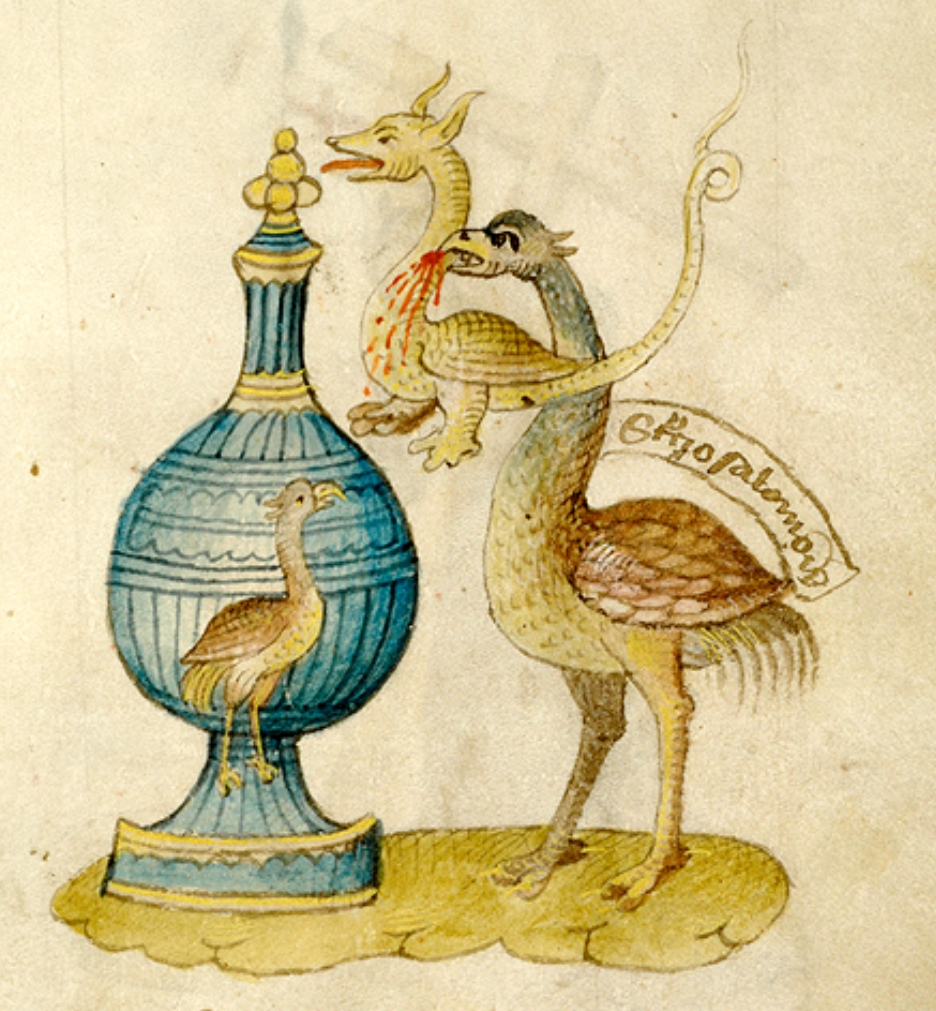
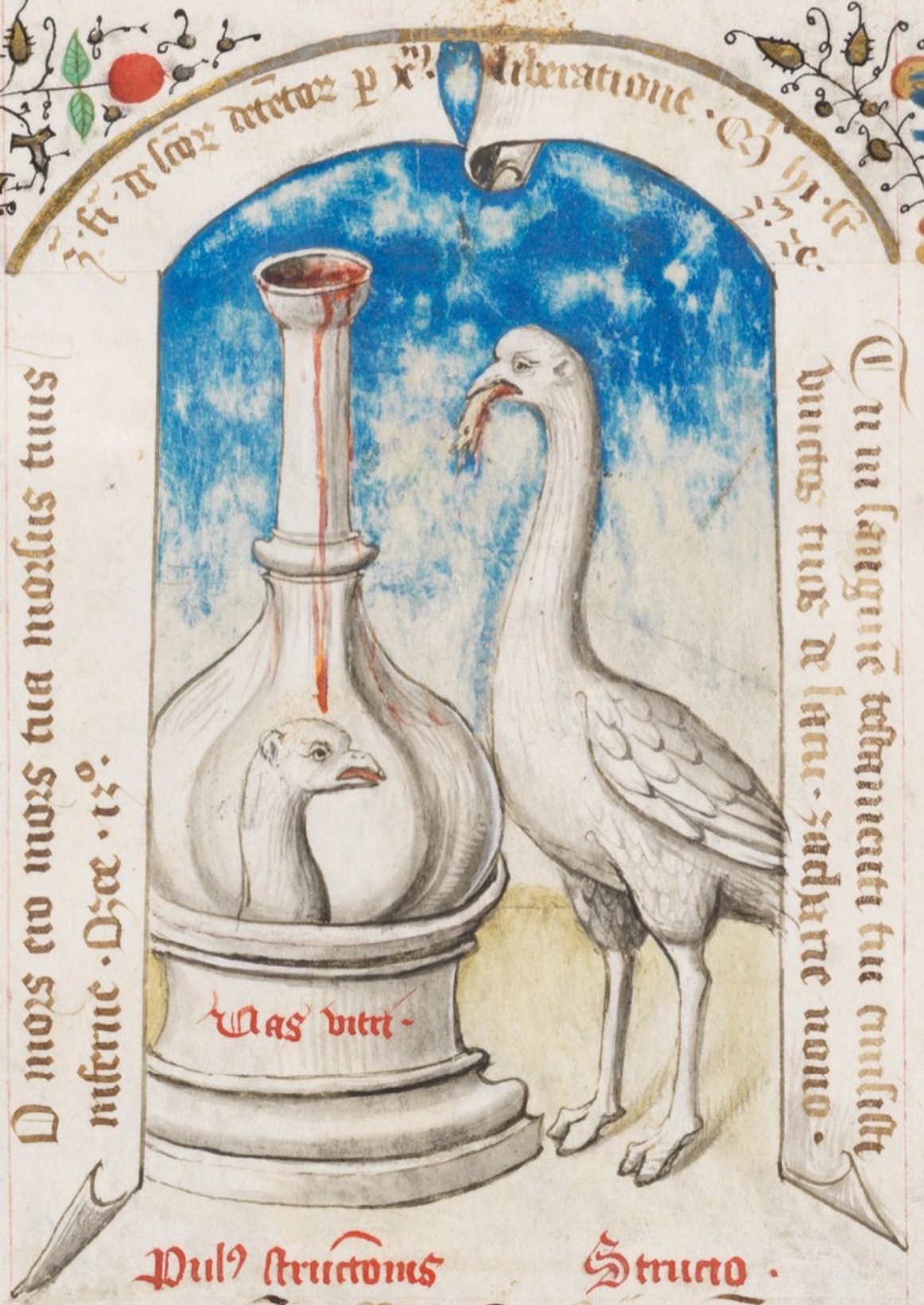
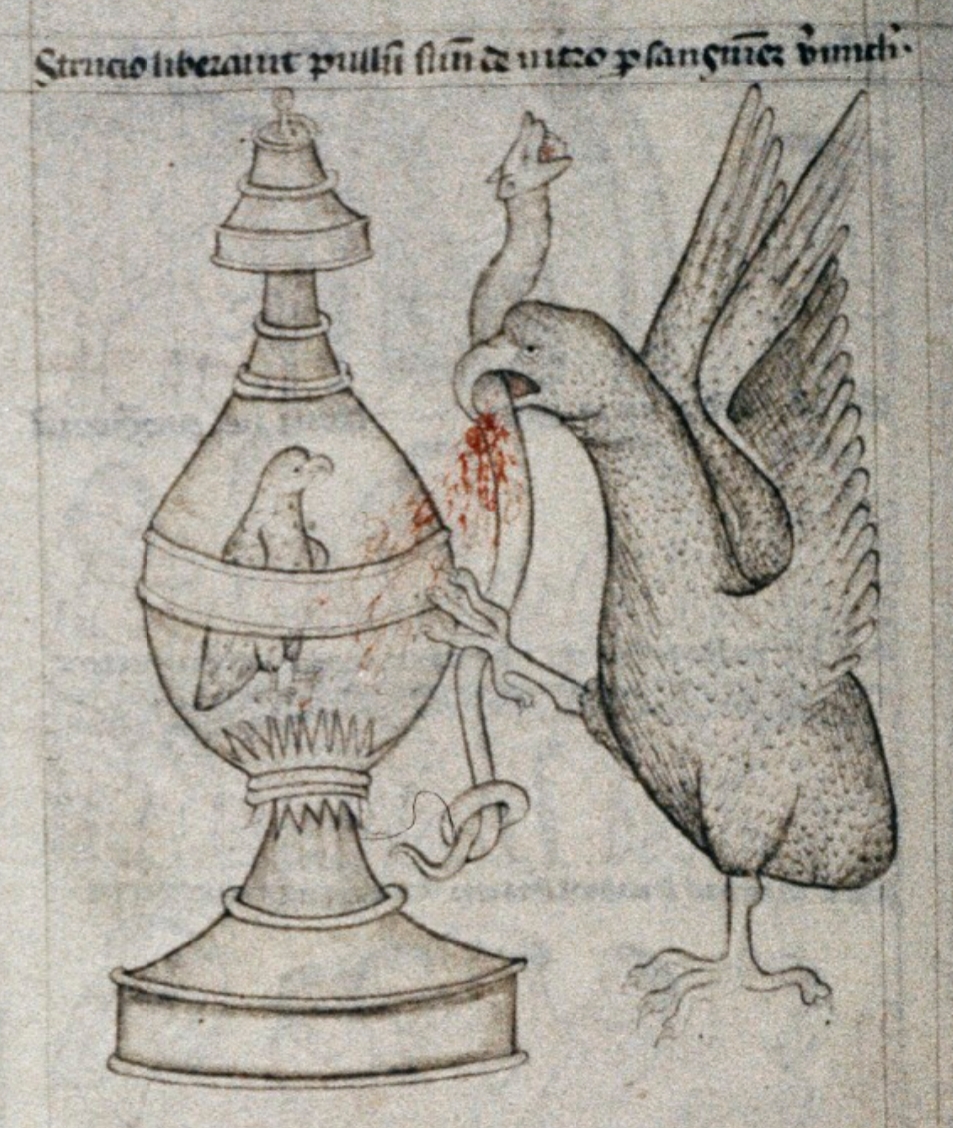
The ostrich freeing its chicks with the thamur worm is illustrated in the majority of the approximately 400 existing manuscripts of the Speculum (see the Gallery tab above). The ostrich is depicted in the usual range of camel-hoofed birds, some looking somewhat like real ostriches but many not. The artists had various ideas of what the thamur worm looked like, since it did not actually exist and was not clearly described in the Jewish or medieval texts. A few images show it as a small worm, but in others it is more like a large snake, a lizard or a dragon. One thing that is found in most illustrations shows how the worm was used to break glass; the ostrich is usually depicted applying the worm's blood to the container.