Rabanus Maurus
Biography
Rabanus (or Hrabanus) Maurus (ca. 780-856), abbot of Fulda and Archbishop of Mainz, was a theological and pedagogical writer. He was born at Mainz about 776 (or possibly 784) and died near there in 856. His name, which is spelled in various ways (Hrabanus, Rabanus, Rhabanus, Reabanus, Raban, Rabano), is connected with Old High German hraban, "raven"; "Magnentius", which sometimes appears before his surname, Maurus, is probably related to his residence in Mainz. At an early age he became a Benedictine monk at Fulda. In 802 he went to Tours to study theology and the liberal arts, under the great scholar Alcuin, from who he received the surname Maurus after the favorite disciple of St. Benedict. After a year of study, he was recalled to Fulda, where he taught at the monastic school and eventually became head-master. In 814 he was ordained as a priest; in 822 he became abbot of the monastery. Under Abbot Rabanus, the monastery flourished, becoming a renowned seat of learning in the Frankish kingdoms. Between 840 and 847 Rabanus became embroiled in royal political struggles, resigned as abbot, and fled from Fulda. In 847, after a reconciliation with the king, he was appointed Archbishop of Mainz.
Writing
Rabanus was said to be the most learned man of his age. His knowledge of scripture, patristics, canon law and liturgy was without compare. The scope of his writing extended over the entire field of sacred and profane learning as then understood. He wrote commentaries on nearly all the books of the Old Testament, as well as the Gospel of Matthew and the Pauline Epistles. He also wrote more secular works such as De computo, a treatise on numbers and the calendar; the Excerptio de arte grammatica Prisciani, a treatise on grammar and his famous encyclopedia, De rerum naturis.
De rerum naturis
De rerum naturis (On the Nature of Things), also known as De universo, is an encyclopedia in 22 books, covering a large range of subjects. It was written between 842 and 847. Rabanus' stated intent was to compile an encyclopedic handbook for preachers. He drew on earlier sources for his information, particularly the Etymologiae of Isidore of Seville, but the organization of the material was his own invention.
The De rerum naturis is an extensively moralized encyclopedia. Its intent was to provide allegorical teaching in addition to providing information on nature. In his prologue Rabanus says:
For in it there are several expositions of the nature of things, and of the properties of words, as well as also of the mystical meaning of things, which is why I thought it should be arranged in such a way, that the prudent reader may find, in a continuous manner, the historical and mystical interpretation of things. And thus he could find enough in this way to satisfy his desire to learn the manifestation of both history and allegory.
The moralizations are religious, specifically Christian, and are often longer than the text on the natural thing being described. This makes it more like a bestiary than the usual thirteenth century encyclopedia.
This list of the books of the De rerum naturis is based on Schipper and Migne.
- On God and angels
- On man, the patriarchs, the status of man
- On people of the old testament
- People of the New Testament, martyrs, clerics, monastics, heretics
- On the scriptures
- On man and the parts of man
- On the ages of man, relations, marriage, death; On domestic animals
- On animals
- On astronomy - the world and the heavens
- On time and the calendar
- On water - oceans, rivers, floods
- On geography - the regions of the Earth, the globe, paradise
- On geography - mountains, valleys, deserts
- On architecture and building
- On the liberal arts
- On language
- On geology - stones, minerals, gems, metals
- On number, music, medicine
- On agriculture
- On war and weapons; On athletics and the games
- On textiles and clothing
- On agriculture and food


Manuscripts
There are about 35 manuscripts containing the full text of De rerum naturis, plus several that do not include all 22 books. Fragments and excerpts are found in other manuscripts. At least three manuscripts are illustrated (Archivio dell'Abbazia, Montecassino, MS 132; Biblioteca Apostolica Vaticana, Pal. lat. 291; Württembergische Landesbibliothek, Cod.theol.et.phil.fol.45); at least one has spaces left for illustrations that were not completed (Biblioteca Apostolica Vaticana, Reg.lat.391). Some of the manuscripts are listed under the Manuscripts tab above.
Animals
The De rerum naturis describes 22 domestic animals in Book 7.8, and 134 wild animals, birds, serpents, fish and worms in Book 8. In these lists, the chapter order and the animals in them are based on the editions by Migne and Schipper, and the manuscript Biblioteca Apostolica Vaticana, Pal. lat. 291.
Book 7, chapter 8 (De pecoribus et jumentis) is about mostly domestic animals and animals hunted for food, plus a few related animals.
Book 8 is on wild animals. It is divided into seven chapters: De bestiis ("beasts", mostly mammals); De minutis animantibus (small animals); De serpentibus (serpents, reptiles); De vermibus ("worms", mostly insects); De piscibus (fish); De avibus (birds); De minutis avibus ("small birds", flying insects).
Rabanus often describes attributes of an animal in several sections, not always contiguous. Minor additions to the animal description are not shown here, though if there are two more separate substantial descriptions they are shown as separate entries, as are the same animal described under different names.
- Verbix vel viribus (wether)
- Aries (ram)
- Agnus (lamb
- Hircus (he-goat)
- Capros et capras (goat)
- Cervi (stag)
- Tragelafi (tragelaphus)
- Hinnuli (doe)
- Lepus (hare)
- Erinatius (hedgehog)
- Sus (pig)
- Aper (boar)
- Juvencus (bull)
- Vacce (cow)
- Bovem (ox)
- Vitulus (cow [calf])
- Bubali (buffalo)
- Camelis (camel)
- Asinus (ass)
- Onager (onager)
- Caballus (horse)
- Mulus (mule)
- Leonis (lion)
- Tigris (tiger)
- Panter (panther)
- Pardus (pard)
- Leopardus (lleopard)
- Rinocerota (monocerus and unicorn)
- Elefantem (elephant)
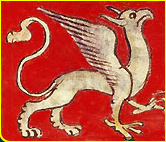
- Gripes (griffin)
- Camaeleon (chameleon)
- Cameleopardus (giraffe)
- Linx (lynx)
- Castores (beaver)
- Ursus (bear)
- Lupus (wolf)
- Canis (dog)
- Catuli (cat)
- Vulpis (fox)
- Simiae (ape)
- Enidros (hydrus)
- Corcodrillum (crocodile)
- Ycnheomon (ichneumon)
- Dracontius (dragon)
- Musio (cat)
- Anguis (snake)
- Colubrum (snake)
- Cerastes (cerastes)
- Draco major (dragon)
- Aspis (asp)
- Dipsa (dipsa)
- Ipnalis (hypnalis, a kind of asp)
- Emorrois (haemorrhois, a kind of asp)
- Prester (a kind of asp)
- Spectabificus (a kind of asp)
- Bailiscus (basilisk)
- Reguli (basilisk)
- Sibilus (basilisk)
- Scorpio (scorpion)
- Vipera (viper)
- Enidris (hydros)
- Ydra (hydra)
- Celidros (chelydros)
- Salamandra (salamander)
- Vermis (worm)
- Areana (spider)
- Cantarida (cantharis)
- Sanguisuga (leech)
- Multipes (millipede)
- Limax (slug)
- Bombices (silkworm)
- Eruca (caterpillar)
- Teredonas (woodworm)
- Tinea (clothes-moth)
- Lumbricus (earth worm)
- Ascaridae (louse)
- Pulices (flea)
- Tarmus (tarmus)
- Ricinus (tick)
- Caenos (dog-fly)
- Usia (uria)
- Cimex (bedbug)
- Canes in mari (sea-dog)
- Lupi (pike)
- Umbrae (astaraz)
- Tructas (trout)
- Solia (sole)
- Ballenae (whale)
- Equi marini (sea-horse)
- Boves marinos (sea-cow or bull)
- Cerulei (ceruleum)
- Delfines (dolphin)
- Porci marini (sea-pig)
- Crocodrillus (crocodile)
- Ippotamus (hippopotamus)
- Mullus (red mullet)
- Mugilis (grey mullet)
- Anguillae (eel)
- Draco marinus (sea-dragon)
- Mure (muraena)
- Concae (pearl-oyster)
- Cocleae (sea-snail)
- Murice (sea-snail)
- Cancros (crab)
- Ostrea (pearl-oyster)
- Spongia (sponge)
- Aquila (eagle)
- Vultur (vulture)
- Grues (crane)
- Ciconiae (stork)
- Cornices (crow)
- Olor (swan)
- Strutio (ostrich)
- Ardea (heron)
- Fenix (phoenix)
- Cinomolgus (cinnamologus)
- Psittacus (parrot)
- Alcion (kingfisher)
- Onacrotalus (bittern)
- Crocodillus genus volatile (trochilus ["flying crocodile"]
- Vespertilio (bat)
- Noctua (owl)
- Bubo (owl)
- Lucina (nightingale)
- Ulala (owl)
- Graculus (jackdaw)
- Pica (magpie)
- Picus (woodpecker)
- Pavo (peacock)
- Gallus (cock)
- Gallina (hen)
- Anser (goose)
- Anes (duck)
- Mergis (mergus)
- Fulica (coot)
- Turtur (turtledove)
- Columba (dove)
- Palumbes (wood-dove)
- Perdix (partridge)
- Coturnices (quail)
- Passer (sparrow)
- Pellicanus (pelican)
- Nocticorax (owl)
- Hirundo (swallow)
- Garrula (jay)
- Uppupam (hoopoe)
- Corvus (raven)
- Cornix (crow)
- Milvus (kite)
- Accipiter (hawk)
- Falconem (falcon)
See also Encyclopedia.