| Ant-lion |
|
| Description | Gallery | Bibliography | Manuscripts |
|
|
|
|
|
|
|
|
|
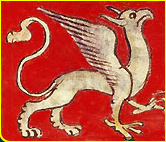
Ant-lion Latin name: Myrmecoleon Other names: Formicaleon, Formicaleun, Mirmicioleon The offspring of an ant and a lion, or the lion of ants
|
|
| General Attributes |
There are two interpretations of what an ant-lion is. In one version, the ant-lion is so called because it is the "lion of ants," a large ant or small animal that hides in the dust and kills ants. In the other version, it is a beast that is the result of a mating between a lion and an ant. It has the face of a lion and and the body of an ant, with each part having its appropriate nature. Because the lion part will only eat meat and the ant part can only digest grain, the ant-lion starves. The ant-lion story may come from a mistranslation of a word in the Septuagint version of the biblical Old Testament, from the book of Job (4:11). The word in Hebrew is lajisch, an uncommon word for lion, which in other translations of Job is rendered as either lion or tiger; in the Spetuagint it is translated as mermecolion, ant-lion. |
| Sources (chronological order) |
Gregory the Great [6th-7th century CE] (Moralia in Iob, Book V, chapter 20, section 40): But in the translation of the seventy interpreters it does not say "the tiger" but "the ant-lion perished because it had no prey." The ant-lion is a very small animal, enemy of the ant, which hides itself under the sand and kills ants carrying bits of grain, and then eats the ants. Ant-lion is said in Latin to be either "lion of ants" or at least, more precisely, "both ant and lion." It is rightly said to be both ant and lion, because by comparison to flying things, or to other small animals, it is an ant, but to the ants it is a lion. It devours them like a lion, but it is devoured by the other animals like an ant. When therefore Eliphaz says, "The ant-lion perished," what is he attacking in blessed Job under this name if not both fear and boldness? As if to say openly: 'You have not been struck unjustly, because you are timid against the strong, but bold against the weak.' As if to say openly: 'Against the clever, fear restrained you, but against the simple, cockiness puffed you up. But the ant-lion does not have its prey because your timid pride is beset by blows and kept from wounding others.' But because we said the friends of blessed Job stood for heretics, it is important for us to say how these words of Eliphaz can be interpreted allegorically. ... (Section 43): This beast spotted with such diversity is rightly called a tiger, though called by the seventy interpreters as we said before, an ant-lion. That animal hides in the dust, as we said, to kill ants carrying bits of grain. So also the apostate angel, cast down on earth from heaven, ambushes the minds of the just as they prepare for themselves nourishment on the path leading to good works. And when he defeats them from ambush, he is like an ant-lion unexpectedly killing ants bearing grain. But he is rightly called an ant-lion, that is lion-and-ant: for he is a lion to the ants, but to the birds a mere ant, because to those who yield to him the ancient enemy is strong, but to those who resist him he is feeble. If his suggestions find assent, he is as unstoppable as the lion; but if they are resisted, he is stepped on like an ant. To some therefore he is a lion, to others an ant. Minds devoted to the flesh can scarcely endure his cruelty, while spiritual minds step on his weakness with the foot of virtue. So heretics, because they take pride in their presumed holiness, say as if rejoicing, "The ant-lion," or at least, "The tiger perished, because he had no prey." As if to say openly: 'The old adversary does not have prey in us because for our purposes he already lies beaten.' So he is mentioned again with the name of ant-lion or tiger because he had already been said to be trampled on in the roar of the lion: for whatever is said out of joy is often repeated. (translation by James J. O'Donnell) Isidore of Seville [7th century CE] (Etymologies, Book 12, 3:10): The ant-lion is so called either because it is equally lion and ant, or because it is the lion of ants. It is a small animal that is hostile to ants; it hides in the sand and kills other ants that are carrying grain. In this way it is like a lion to ants though it is like an ant to other animals. Philip de Thaun [c. 1121 CE] (Bestiaire) Under the heading "Est formicaleon invisum animal formicis" ( Vincent of Beauvais [c. 1190 - 1264] (Speculum Naturale) (from Guillaume le Clerc [13th century] (Bestiaire) ( Cambridge University Library MS Gg. 6.5 [15th century] ( |
| Description | Gallery | Bibliography | Manuscripts |
|
|
|
|
|
|
|