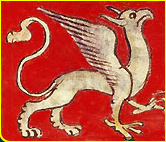
Monocerus
| Latin name: | Monocerus |
| Other names: | Eenhoren, Enoren, Monacheros, Monoceros, Monocheros, Monocrete, Renoce, Rhinoceros, Rinocerota, Rynoceron, Rynocerote, Unicorn |
| Category: | Beast |
A fierce beast with a single long horn


General Attributes
Some sources treat the monocerus and the unicorn as the same beast, while others consider them two different beasts. In those that consider them as different, the monocerus is usually described as having the head of a stag, the body of a horse, the feet of an elephant, the tail of a boar, and a single very long black horn growing from the forehead. It makes deep lowing sounds. It is the enemy of the elephant and when fighting it aims its horn at the belly of its opponent.
See the entry for the unicorn for other traits sometimes ascribed to the monocerus.
Reality
The monocerus is probably based on the Indian or African rhinoceros.